 by
by 
This week in Yellowstone National Park, from August 21st through August 27th, I will let you know how and where to see an overlooked geyser erupt, talk about bear bells, discuss the history of Quake Lake, and share a mountain summit that few ever hike to. I will also give you the complete weather forecast, wildlife report, the news, and everything else you need to have an incredible time, “This Week in Yellowstone.”
LISTEN TO THIS AS A PODCAST!
Apple: https://podcasts.apple.com/us/podcast/this-week-in-yellowstone-national-park/id1789397931
Spotify: https://open.spotify.com/show/41E5WWldz4s7n6NXh2Lahr
RSS: https://rss.com/podcasts/this-week-in-yellowstone-national-park/
Disclaimer: I might miss a few details, so feel free to reach out with questions! I also mention park locations casually—if you’re unfamiliar, a quick search can help.
Also, this podcast is a passion project—I’m not paid or sponsored. If you enjoy it, I’d love a review or a quick email! To support my work, check out my guidebooks on hiking and wildlife watching, or join me for a guided Yellowstone tour. For details, visit outdoor-society.com or reach out directly!
THIS WEEK’S YELLOWSTONE NEWS

I Reported a Fire
Earlier this week, I was leading a tour near Bunsen Peak and Osprey Falls when I spotted smoke rising from a forest east of Osprey Falls. Since I had service on my cell phone, I called Yellowstone dispatch and reported it, even giving an approximation of the lat and long. They told me I was the first to report it, which was pretty cool. Within an hour and a half, a reconnaissance plane flew over, followed by a helicopter an hour later. For the next few hours, the helicopter worked to extinguish the newly formed fire, using a bucket to dump water on the smoldering landscape. Within 3.5 hours of my calling it in, the helicopter left, fully taking care of the fire. Hopefully, any embers or smoldering stumps do not flare up, and the fire is properly dead. I am assuming it is. It only appeared to burn less than an acre. This was the first time I had reported a backcountry fire, and I was pretty happy I could be of service and make sure it was taken care of before it became a bigger issue. Thanks go out to the park staff and firefighting crews for responding so quickly!
Fires in the Park
The Osprey fire, which I reported was one of many fires that were started over the last week, was due to thunderstorms and numerous lightning strikes in the region. As of the 18th of August, there are a handful of fires burning in the park, and fire danger is very high. Please follow all fire rules and regulations.
The Late-August Visitation Drop is Upon Us
Right now, there is a weird dip in visitation to Yellowstone. It isn’t super noticeable for those who don’t frequent the park often, but for those of us always in the park, things feel a small percentage calmer. Why is this? We are in a week or two gap between people visiting the park for the summer and people hoping to avoid visiting the park during the peak summer months. Kids are headed back to school, but we’re still not on the cold side of Labor Day. Again, the percentage difference is minimal, but the end of the full tourist season is within sight. Now, some of you may rejoice and assume that the park empties out after Labor Day, but be aware that September visitation is typically only slightly lower than August. The old “the kids are back in school, so the park is empty” thinking is wildly outdated and inaccurate, especially in the first half of the month. You can doubt me on this, but the visitation statistics don’t lie.
EXPERIENCE OF THE WEEK
Watch Daisy Geyser Erupt
I often hear people say that the only thing to do around Old Faithful is to see Old Faithful erupt. Once they see it go off, they get back in their cars and leave. They are missing out on a lot. While I could spend an hour or more talking about all there is to do in the area, I want to focus this week’s experience section on one of my favorite overlooked gems in the region, Daisy Geyser. Located a mile walk along a mostly paved path, Daisy is one of the most predictable geysers in Yellowstone, and I think it feels like a mini version of Old Faithful, with almost zero crowds.
If Old Faithful is Yellowstone’s superstar, Daisy Geyser is the under-the-radar favorite you don’t want to skip. Tucked into the Upper Geyser Basin, Daisy is known for being one of the park’s most reliable “predictable” geysers, which means you can plan your day around seeing it instead of leaving it up to chance. When it blows, Daisy shoots a powerful jet of water about 75 feet into the air for three to five minutes, long enough to settle in, snap some incredible photos, and even have time to put your phone away and be in the moment with the geyser.
One of the best parts about Daisy is how easy it is to catch. Rangers post expected eruption windows at the Old Faithful Visitor Education Center, and the National Park Service lists its average interval at about two hours and forty-five minutes, with each eruption lasting roughly three and a half minutes. Hiking on the easy, mile-long path to get there is also a breeze for nearly all visitors, making it a fun experience for all.
What makes Daisy even more interesting is that it’s part of the Daisy Group, which includes Splendid Geyser, Comet Geyser, and Brilliant Pool. They share underground plumbing, so their activity can affect each other. Daisy is generally steady, but Splendid’s rare eruptions sometimes throw Daisy’s schedule off. Meanwhile, Comet is almost always splashing away nearby, and Brilliant Pool gives a colorful, calm contrast to all the drama. It’s like a mini-lesson in Yellowstone’s hydrothermal diversity, all in one spot.
Getting to Daisy is straightforward: just follow the trail from Old Faithful toward Morning Glory Pool and watch for signs to the Daisy Group. It’s a pleasant walk through the basin, and the path itself offers a front-row seat to one of the densest geyser fields in the world. Give yourself a cushion; arriving a little early before the posted eruption window is always smart, and pick a spot where you can watch Daisy from the side to get the best angle. Pairing Daisy with a visit to Riverside Geyser (another predictably timed favorite just down the way) makes for an easy, rewarding outing. Throw in Morning Glory and you will have yourself a great day.
Daisy is also fun from a science-minded perspective. Watching it erupt after checking the ranger boards is like seeing the park’s geology and hydrology in action. Predictions are based on tracking past intervals and eruption lengths, so you can test how close reality comes to the numbers. It’s a reminder that Yellowstone’s hydrothermal features are both wild and pattern-rich, which is exactly why scientists and geyser enthusiasts alike love keeping track of them.
Daisy’s eruptions typically hit that 75-foot mark, last for 3-5 minutes, and is usually predictable with eruption intervals of 110-240 minutes. That balance of drama and predictability is rare in a large geyser, and it’s why Daisy has earned a reputation as one of the park’s most rewarding, yet still underrated sights.
So, why make the effort to see Daisy? Because it’s reliable without being boring, dramatic without being overcrowded, and uniquely beautiful thanks to the remote feeling location. You’ll get the thrill of anticipation, the satisfaction of a long, photogenic eruption, and the bonus of wandering one of the most spectacular geyser basins on the planet along the way. Daisy may not have Old Faithful’s name recognition, but if you ask anyone who’s seen it erupt, they’ll probably confirm what I am saying: Daisy is one of Yellowstone’s truly overlooked geothermal gems.
TIP OF THE WEEK
Leave the Bear Bells At Home
When it comes to hiking in bear country, a lot of people rely on bear bells as a simple safety measure. But the truth? They’re really not that effective.
Out in the wild, bear bells largely fall short of expectations, especially compared to actually making noise with your voice, which is much more reliable at preventing surprise encounters. Bells are often too soft, especially when there’s background noise like wind or rushing water, and they don’t carry far enough to give bears adequate warning.
To make matters worse, the sound of a bell doesn’t naturally signal danger to a bear. It doesn’t resemble a human voice, breaking twigs underfoot, or calls from other animals, so bears don’t usually interpret it as a warning. Some experts even caution that the novelty of a jingle might actually pique a bear’s curiosity, leading it toward you rather than away. I have also heard from bear experts that bells are more like bird noises to bears, and are often ignored.
This bear expert is not alone in their skepticism of bear bells. There is a detailed study in Katmai National Park had a biologist jingling bells in front of brown bears; 15 different bears ignored the sound, but reacted immediately when the researcher snapped a pencil.
So what does work? Consistent, human-generated noise, like talking, singing, calling out, or clapping, is far better at alerting bears to your presence. Bears instinctively avoid humans if they have the chance. Hikers who talk or make noise tend to avoid surprise encounters entirely. As someone who hikes all year in the park, I talk loudly often, making sure that any animals in the area know I am around.
I understand that many people head into nature to be in silence and solitude. You can still get that, but talk to yourself or at least give a good shout every few minutes, particularly around blind corners or dense areas of vegetation. It might feel silly, but it works and will let bears know you are around. It is also irresponsible to try to move silently through the wilds of Yellowstone, as you are just asking for a wildlife encounter by doing so.
One more thing that many experts emphasize: don’t let a bell give you a false sense of security. Relying on a bell can make you less vigilant, which is dangerous in bear country. Always carry bear spray and stay alert; bells are no substitute for preparedness.
So when you head out on a hike in Yellowstone, don’t bother with bear bells. Stick with real human noise, especially your voice. Stay bear aware, consider hiking in a group if you can, as you are more likely to talk, and always carry bear spray when you are on a trail. That’s the kind of smart preparation that can genuinely make a difference.
RANDOM YELLOWSTONE FACT OF THE WEEK
The Quake Lake Earthquake
On the evening of August 17, 1959, a mighty magnitude-7.3 earthquake struck near Hebgen Lake, about 6.5 miles west-northwest of West Yellowstone, Montana, just outside Yellowstone National Park’s boundary. Occurring at 11:37 p.m. MST, the quake lasted nearly 30–40 seconds and remains one of the strongest ever recorded in the Rocky Mountain region of the continental U.S.
The earthquake triggered the Madison Slide, an enormous landslide that swept approximately 37 to 50 million cubic yards of rock, mud, and debris into Madison Canyon. The slide carved a natural dam across the Madison River, devastating Rock Creek Campground and trapping many campers. Tragically, 28 people lost their lives in this disaster. Emergency efforts pushed survivors to higher ground, notably at Refuge Point, until roads could be cleared and rescue operations conducted.
Behind the natural dam, waters quickly accumulated, giving birth to Quake Lake, a 6-mile-long, 125-foot-deep reservoir.. The U.S. Army Corps of Engineers mobilized rapidly, digging spillways to safely drain excess water and prevent catastrophic flooding downstream.
Effects Felt in Yellowstone National Park
Though the quake’s epicenter was outside the park, its impact reverberated deeply within Yellowstone. Roads connecting Mammoth and Old Faithful were blocked by rockslides, and a massive chimney at the iconic Old Faithful Inn collapsed, prompting the evacuation of guests. The huge rock chimney at the historic Old Faithful Inn fell to the south into the dining room. Fortunately, the dining room was empty as it had been closed just before the quake. Everyone at the Inn had to move to the Old Faithful Lodge because the quake had set off the sprinkling system, and everyone and everything was soaked.
Perhaps even more fascinating was the insistent reaction of Yellowstone’s hydrothermal systems. Within days, 289 springs along the Firehole River began erupting like geysers, including 160 springs that had never erupted before. At least 590 springs turned turbid from the disturbance. Over the following years, some features returned to form, while others remained changed.
Two especially dramatic changes included:
- Seismic Geyser, near the Upper Geyser Basin, emerged from a ground fracture post-quake. Over 2.5 years, it evolved into a vigorous geyser jetting up to 50 feet high before quieting by 1971.
- Sapphire Pool, previously a calm hot spring in Biscuit Basin, surged 6-8 feet high and transformed into a powerful geyser. In peak eruptions, it blasted 150 feet skyward before eventually reverting to its tranquil name in later years.
Old Faithful itself showed changes in eruption timing. Its average interval increased from 61.8 minutes pre-quake to around 67.4 minutes by December, up to ~93 minutes in later years, though it’s unclear how directly the earthquake influenced this (isu.pressbooks.pub)(USGS).
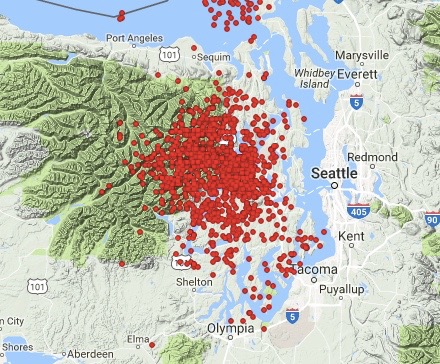
The power of the quake was felt across the western U.S., from Denver to Seattle.
The quake reshaped the region’s landscape in enduring ways. Fault scarps up to 20 feet high remain visible along Hebgen Lake and Red Canyon. The quake triggered hundreds of aftershocks through the following months.
In 1967, the Earthquake Lake Visitor Center was opened by the U.S. Forest Service atop the landslide debris. It now features displays on earthquake science, a live seismograph, and outdoor exhibits overlooking Quake Lake and the slide scar.
This natural disaster serves as a vivid reminder: Yellowstone’s region isn’t only about volcanic power, it’s also highly seismic. If a similar-magnitude quake happened today, the impact on park infrastructure, tourism, and visitor safety would be massive, given the population growth and increased visitation since 1959.
Every geologic crack, every geyser’s change, and every bare patch of landslide mark tells a story of Yellowstone’s dynamic and evolving landscape. The Hebgen Lake earthquake dramatically altered the park’s natural and human systems, but it also deepened understanding of this active landscape.
Read a firsthand account: https://www.yellowstone.co/nightofthebear.htm
SNOWPACK UPDATE
Not in this week’s episode. This will be back in October, probably.
ROADS CONDITIONS
All major roads and most side roads are open right now in and around Yellowstone National Park. This includes Dunraven Pass and the Beartooth Highway.
For up-to-date information, call (307) 344-2117 for recorded information, or sign up to receive Yellowstone road alerts on your mobile phone by texting “82190” to 888-777.
CAMPING INFO
Every campground in the park that is going to open this year is open. There are still a surprising number of sites available this coming week, especially after the weekend. If you are on the fence about camping or visiting, consider booking a site and coming out. You should be able to find a spot somewhere in the park.
WILDLIFE WATCHING UPDATE
You have to listen to the podcast to get this information. Sorry.
Apple: https://podcasts.apple.com/us/podcast/this-week-in-yellowstone-national-park/id1789397931
Spotify: https://open.spotify.com/show/41E5WWldz4s7n6NXh2Lahr
RSS: https://rss.com/podcasts/this-week-in-yellowstone-national-park/
TRAIL ALERTS AND UPDATES
Currently, as of the time of this recording, all trails that are supposed to be open in the park are open. Trails in the bear management areas are not included in that statement. All the information on trail conditions can be found on the Backcountry Conditions Page of Yellowstone National Park.
TREK OF THE WEEK
Big Horn Peak off of Highway 191
There are hikes to mountain tops, and there are HIKES to mountain tops.
Bighorn Peak, located on the western boundary of Yellowstone National Park, is the latter. Mostly hidden from view, this summit is one of the many hidden gems one will find when deciding to go beyond the boardwalks. Located on the western boundary of Yellowstone National Park, Bighorn Peak provides a day of serenity and relative solitude in Yellowstone. Many may be deterred by the animals in the area, the remoteness of the peak, and the steepness of some sections of the trail, but those who are seeking a truly stunning mountain hike in Yellowstone will quickly become enamored by Bighorn Peak.
Along this hike, you probably won’t see many people, as this section of the park is largely overlooked by the masses driving between Big Sky and West Yellowstone. There is a high likelihood that you won’t see anyone else at all. Instead, you will probably see wildlife, sweeping views, wildflowers, and a landscape that few who visit Yellowstone ever see, which is why I sincerely think you’ll enjoy this adventure.
Starting at the Black Butte trailhead along Highway 191, between the Montana towns of Big Sky and West Yellowstone, the out-and-back route up to Bighorn Peak is a little over 12.5 miles in length and gains roughly 3,300 feet in elevation, topping out right around 9,900 feet above sea level.
The trail darts away from the pavement quickly, with road noise being replaced by birds and the sound of wind through the trees. In the height of summer, wildflowers are easily found, bringing a splash of color to an already gorgeous landscape. Bighorn Peak is for those looking for an adventure far from the beaten path of day hikers. It is for adventurers who want to summit a mountain that few have seen. It is for hikers hoping to have a day in the wilds of Yellowstone, where incredible memories are waiting to be had around every corner.
The majority of the trail is an easy-to-follow trail, with the only bit of exposure found on the final jaunt to the summit of the mountain. Even that exposure isn’t anything to worry about, as the trail is wide enough for stock to use on long backpacking trips across the area.
This trail isn’t for new hikers or those looking for an easy day. Instead, this adventure is for those looking for a unique experience in Yellowstone that will inspire deep adventures into the park’s backcountry. If you are looking for a mountain day that even locals overlook, Bighorn Peak is the adventure for you.
I am recommending Bighorn this week for a couple of reasons. One is that pretty soon, this area will be inaccessible to hikers, as early fall snows will cover it. Another is that I rarely recommend hikes along Highway 191, and feel like skipping this one is a shame, especially since we have such long daylight hours now. The final reason is that pretty soon, bears will enter hyperfasia, and I tend not to recommend remote mountain peaks when they are feasting for the fall.
Honestly, this peak is a hidden gem in Yellowstone and one I am really happy I get to share. Sure, it is not the easiest trek, but for experienced hikers looking for a memorable day on a remote trail and hidden summit, you’ll love this one. You can also tag this summit as part of the Sky Rim Trail, which you can find more about in my guidebook.
NEXT WEEK
In next week’s episode, I’ll return with all of the information you need to have a good week in the park, including wildlife, weather, and trail updates.
Until then, happy trails!