 by
by 
This week in Yellowstone National Park, from August 7th through August 13th, give an update on the fire danger in the park, let you know of a cool event taking place in Gardiner to end this week, let you know about wildlife watching etiquette, and even give you some insight into a cool geologic event you can see in the park. I will also give you the complete weather forecast, wildlife report, a trail to hike, and everything else you need to have an incredible time, “This Week in Yellowstone.”
LISTEN TO THIS AS A PODCAST!
Apple: https://podcasts.apple.com/us/podcast/this-week-in-yellowstone-national-park/id1789397931
Spotify: https://open.spotify.com/show/41E5WWldz4s7n6NXh2Lahr
RSS: https://rss.com/podcasts/this-week-in-yellowstone-national-park/
Disclaimer: I might miss a few details, so feel free to reach out with questions! I also mention park locations casually—if you’re unfamiliar, a quick search can help.
Also, this podcast is a passion project—I’m not paid or sponsored. If you enjoy it, I’d love a review or a quick email! To support my work, check out my guidebooks on hiking and wildlife watching, or join me for a guided Yellowstone tour. For details, visit outdoor-society.com or reach out directly!
THIS WEEK’S YELLOWSTONE NEWS
Fire Danger Update
Fire danger is VERY HIGH in Yellowstone. Campfires are only permitted within the fire rings in campgrounds and at some, not all, backcountry campsites. All campfires must be attended at all times and be cold to the touch before abandoning. Soak, stir, feel, and repeat until out cold.
As of the time of recording, there are currently three active fires in Yellowstone, with the largest having burned 26 acres. The other two have burned a combined 1.5 acres.

New Bridge is Nearly Done
No, not the bridge you are thinking of, which I am guessing you are thinking is the huge new bridge as you head from Tower Junction to Lamar. That one should be done at the end of the tourist season next year. The bridge that is nearly done is the Lewis River Bridge near the South Entrance. Scheduled to be completed in the fall of 2024, the new bridge is finally nearing completion. The new bridge will improve visitor safety and access, and it will expand parking and viewing areas of the scenic falls nearby.
EXPERIENCE OF THE WEEK
The Voices of Yellowstone: First Peoples Celebration is currently taking place in Gardiner, Montana, right at the gateway to Yellowstone National Park. Hosted by Yellowstone Forever, in partnership with Yellowstone National Park and in collaboration with the Pretty Shield Foundation, Rocky Mountain Tribal Leaders Council, and the Gardiner Chamber of Commerce and Visitor Center, this multi-day gathering is designed to honor and celebrate the enduring cultures, traditions, and contributions of the Indigenous Peoples of the Yellowstone region, past, present, and future.
The event kicked on on the evening of Sunday, August 3. The celebration started with a heartfelt opening ceremony featuring a traditional blessing, drum circle, and welcoming remarks. This marked the start of a week rich in cultural immersion, education, and community connection.
Now, for those of you listening, each evening, starting at 8 p.m., community members and visitors alike are invited to gather at the Illuminated Teepees, a striking installation hosted by the Pretty Shield Foundation and Rocky Mountain Tribal Leaders Council. This year’s theme, The Lighting of Teepees: Coloring the World of Cultures, brings focus to the vibrant diversity of Indigenous traditions. Each night, a featured Tribal speaker or musician will share stories, songs, and teachings, creating a powerful opportunity for all attendees to hear directly from Indigenous voices and learn in a deeply personal and engaging setting.
Throughout the week, visitors can also explore a Tribal Art Market located at the Yellowstone Forever headquarters, just across from Arch Park. Here, Indigenous artists will showcase and sell a wide array of traditional and contemporary arts and crafts, offering a chance to support Native artisans and take home a piece of Yellowstone’s cultural legacy.
Adding to the immersive experience, cultural tours led by Native American experts will run throughout the week. These tours offer deeper insight into the Indigenous history, sacred sites, and cultural connections that span across the Yellowstone landscape, connections that predate the park’s 1872 founding by thousands of years. Yellowstone, often seen through a lens of wilderness and geology, is also a living cultural landscape where over two dozen Tribal Nations maintain ancestral ties. These tours aim to reframe the park’s story by centering Indigenous perspectives.
The week of celebration will conclude on Friday, August 8, with a community potluck hosted by the Gardiner Chamber of Commerce and Visitor Center. This gathering is meant to bring people together, locals, visitors, and Tribal community members, in the spirit of sharing food, conversation, and connection.
More than just an event, Voices of Yellowstone is a movement toward recognition, inclusion, and cultural continuity. As Native scholar and activist Winona LaDuke has noted, “We are not artifacts in a museum. We are people. We have our history, but we also have our future.” Events like this serve as a vital bridge, reminding all who visit that Yellowstone is not just a park, but a homeland with stories and relationships that continue to this day.
I apologize for not mentioning this last week, as the press release was not sent my way. If you do miss this event, I strongly encourage you to head down to Old Faithful and visit the Yellowstone Tribal Heritage Center. The Yellowstone Tribal Heritage Center highlights Native American artists, scholars, and presenters, providing an opportunity for Indigenous peoples to directly engage visitors through formal and informal education. The Yellowstone Tribal Heritage Center is centrally located between Old Faithful Lodge and Old Faithful Visitor Education Center. It is open until October 18.
TIP OF THE WEEK
Etiquette While Watching Wildlife in Yellowstone National Park
Every year, millions of people visit Yellowstone National Park hoping for a glimpse of its iconic wildlife, bison grazing in golden valleys, grizzly bears roaming distant hillsides, and wolves loping across meadows. These encounters are unforgettable for those of us watching, but wildlife watching in Yellowstone also comes with responsibility. How visitors behave around wildlife affects not only their safety, but also the animals’ well-being and survival. A careless moment, getting too close, leaving food out, blocking an animal’s path, can stress or harm wildlife and even lead to fatal consequences for the animal. Following proper etiquette ensures that Yellowstone’s wild residents stay wild and that future visitors can experience them, too.
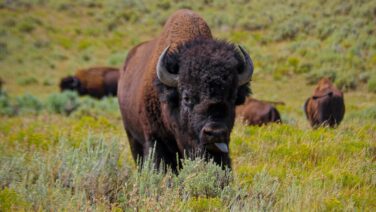
The most well-known rule is to “Keep Your Distance.” Stay at least 100 yards from bears and wolves, and 25 yards from all other wildlife. These distances are the law, enforced by park rangers to protect both people and animals. Even seemingly calm animals can react suddenly, bison can run three times faster than a person, elk and moose can charge without warning, and predators will defend themselves if they feel threatened. If an animal moves closer than the recommended distance, slowly back away. Never approach for a better photo.
When watching wildlife from a pullout, “Use Your Car as a Viewing Blind.”
When watching wildlife from the road, stay inside your vehicle or next to it. Pull completely off the roadway into a designated pullout or the shoulder without blocking traffic. A vehicle acts as a barrier, making wildlife less likely to feel threatened, and it keeps you safer, especially around predators.
Along these lines, do not stand in the road. Ever. The road is for driving, and while this sounds like a basic thing to say, very often people will be on the road while watching wildlife. Also, when driving through an area where crowds are watching wildlife, drive slowly and stay alert. Every few years, a person is hit and sometimes dies as they cross the road, due to a driver either being distracted or speeding through a wildlife area.
Of course, “Never Feed Wildlife”
Feeding wildlife is illegal and dangerous. Animals that get human food lose their natural wariness and often become aggressive. In Yellowstone, “a fed animal is a dead animal” is more than a saying; food-conditioned animals often must be removed from the park for safety. Keep food secured in vehicles, bear boxes, or on bear poles when in the backcountry.
Finally, for the things everyone should know, “Use Binoculars or Spotting Scopes”
Good optics allow you to observe animals closely without disturbing them. This is especially useful for predators, distant herds, or cliff-dwelling species like mountain goats. Don’t walk through the prairie to get a better view or picture. Let wild animals be wild.
That brings us to some of the lesser-talked-about rules for wildlife watching. The first is behavior at wildlife traffic jams.
When animals appear near roads, traffic will quickly pile up. If you stop, do not stop on the road. Pull over fully at a designated pullout. If there is no pullout around, that isn’t an excuse to stop.
While those who listen often know I always say, “Do not stop on the road,” there is actually one exception. Animals in Yellowstone need to be able to travel freely, be it across a field, a river, or a road. This means that a gap in the road needs to occur so the animals can do so. Please note that this advice is mainly for bear and wolf jams, as bison jams are a whole other event, which I talked about on the June 26th episode.
When there is a bear or a wolf near the road, please leave a large gap in the road for the animals to cross. I know that many will want to drive by to get that perfect picture from their car window, but not allowing wildlife to cross the road adds stress and worry to the wildlife, which could lead to aggressive or panicked behavior. Do not surround an animal or block its movement. Doing this makes the wildlife encounter safer and calmer for both humans and animals alike.
This is one of the most important ones: “Keep Your Noise Low.”
A lot of the time, when people are out watching bears or wolves, they are so loud. Kids may scream, car horns may honk when doors are locked, and conversations are done at a near yell. I get that there is excitement, but loud noises are a deterrent to the wildlife. The louder it is, the more likely the animal will move away and leave the area. You are also ruining everyone else’s experience by disrupting their enjoyable experience. Speak in a whisper or a low voice, avoid yelling, and be conscientious of those around you.
Oh, also move slowly. Too often, I see people exiting their vehicle when they know there is a bear or a wolf around and start running to where they can see it. Be calm and walk quietly to the viewing area. Please.
Follow Leave No Trace
Finally, please be aware of trash, papers, and anything else loose in your vehicle when you exit it. More often than not, areas with wildlife near the road are often the areas with the most trash on the ground. As people quickly exit their vehicles for a better look, the wind may blow trash out of your door and quickly get too far away from you. The best way to avoid this is to always have everything secure in your car well in advance.
Respecting wildlife is about more than following rules; it’s about protecting Yellowstone’s wild character. Every respectful encounter we have helps keep the park’s animals healthy, safe, and free to live as they always have.
RANDOM YELLOWSTONE FACT OF THE WEEK
Yellowstone is a land shaped by powerful forces, from tiny heat-loving microbes to massive herds of bison, and from ancient glaciers to violent volcanic eruptions. Nearly everything in this landscape traces back to geology, and few features show that more clearly than the petrified trees standing high above the northern range.
About 50 million years ago, Yellowstone looked very different. Back then, a chain of volcanoes known as the Absaroka Range, separate from today’s Yellowstone hot spot, was active along the park’s eastern and northern edges. When these volcanoes erupted, their heat melted snow and ice on nearby peaks, sending massive slurries of mud, ash, and rock (called lahars) rushing down the slopes.
These lahars buried entire forests in place, trees, stumps, leaves, even the surrounding soil and pollen. Some of the species entombed during this time, like spruce and alder, still grow in Yellowstone today. Others, like redwood, magnolia, and maple, tell us the climate here was once much warmer and wetter, more like the Pacific Northwest or even northern California.
What’s especially fascinating is how these trees became petrified. Over time, groundwater rich in dissolved minerals like silica and calcite, released from the volcanic ash, seeped into the buried wood. As this mineral-rich water moved through the tree’s structure, it slowly filled the hollow cells used for transporting water and nutrients. Eventually, the wood decayed away, but the minerals stayed behind, forming a perfect stone replica of the original tree, right down to the microscopic cellular details.
This process, known as permineralization, can take millions of years. And because Yellowstone’s petrified trees were buried so quickly and preserved so well, they offer an unusually detailed snapshot of the park’s ancient forests. In fact, multiple layers of petrified forests, as many as 27 in some places, are preserved on top of each other in areas like Specimen Ridge and Amethyst Mountain, revealing a long history of repeated volcanic activity and forest regrowth. The Absaroka volcanism lasted for roughly 15 million years. In that time, there were alternating periods of activity and dormancy. The active periods caused trees to be encased and eventually fossilized. During the ensuing dormancy, new trees grew up on top of the old, only to be encased by the next volcanic activity.
Unlike some fossil forests where logs are scattered across the ground, many of Yellowstone’s petrified trees are still standing upright, rooted where they originally grew. These “forests frozen in time” provide a rare window into what life was like during the Eocene, a time when Yellowstone looked nothing like it does today.
So, if you’re driving or hiking through the northern range, take a moment to look up at the rocky ridges. Those stone stumps perched high above aren’t just dead trees; they’re ancient survivors, turned to stone by fire, water, and time. The easiest place to see a petrified tree in Yellowstone is near Tower-Roosevelt, along the road simply labeled “Petrified Tree.” It is a tree in a cage, to protect it from people stealing chunks of it, so it is a little underwhelming to some. However, if you have never seen a petrified tree before, take a quick stop here as you drive the northern range. Not only will you get to see the tree, but you may also see a bear, as black bears like to hang out in this region quite often. If you want to hike to see some out in nature, keep listening as my hike of the week will lead you to some.
Finally, I want to remind everyone that it’s illegal to remove any natural features from the park, including petrified wood. These geologic treasures are protected for everyone to learn from and enjoy.
WEATHER FOR THE COMING WEEK
Lamar Valley: The weather for Lamar this coming week will be decent. Expect highs in the 70s and 80s and lows in the 40s pretty much every day. Friday should be cooler, with highs only in the 60s and lows in the 30s. There is minimal precipitation in the forecast, but expect thunderstorms every day.
Gardiner: Gardiner is going to have pretty steady weather. Expect highs in the 70s and 80s every day, and lows in the 40s. There is a small chance of rain on Thursday and Friday, but it is less than a 20% chance. Still, expect a thunderstorm every day, just in case.
West Yellowstone: The weather should be even steadier in West Yellowstone this week. After a windy Thursday, expect mostly sunny skies every day, with highs around 70 and 80 and lows in the 30s. The high on Friday should be below 70, with a low around freezing.
Cody: Cody should be pretty great this week. Highs will be in the 70s and 80s, with lows in the 50s. Most days do not have a chance of rain, but I would still expect a thunderstorm, because that is what happens out here.
SNOWPACK UPDATE
Not in this week’s episode. This will be back in October, probably.
ROADS CONDITIONS
All major roads and most side roads are open right now in and around Yellowstone National Park. This includes Dunraven Pass and the Beartooth Highway.
For up-to-date information, call (307) 344-2117 for recorded information, or sign up to receive Yellowstone road alerts on your mobile phone by texting “82190” to 888-777.
CAMPING INFO
Every campground in the park that is going to open this year is open. There are still a surprising number of sites available this coming week, especially after the weekend. If you are on the fence about camping or visiting, consider booking a site and coming out. You should be able to find a spot somewhere in the park.
WILDLIFE WATCHING UPDATE
You have to listen to the podcast to get this information. Sorry.
Apple: https://podcasts.apple.com/us/podcast/this-week-in-yellowstone-national-park/id1789397931
Spotify: https://open.spotify.com/show/41E5WWldz4s7n6NXh2Lahr
RSS: https://rss.com/podcasts/this-week-in-yellowstone-national-park/
PICK UP A GUIDEBOOK
Love what you have heard on this podcast and want more information on wildlife watching? Get a copy of my wildlife-watching guidebook to the region! Available in both ebook and paperback formats, my book will help you spot wildlife like a seasoned local. Please consider buying a book directly from me, as I make nothing when they are sold on Amazon. Grab your copy now at outdoor-society.com!
TRAIL ALERTS AND UPDATES
Currently, as of the time of this recording, all trails that are supposed to be open in the park are open. Trails in the bear management areas are not included in that statement. All the information on trail conditions can be found on the Backcountry Conditions Page of Yellowstone National Park.
TREK OF THE WEEK
If you love short and steep trails, this hike is for you! Not only will the views be truly spectacular when you hike this trail, but you’ll also have a chance to come across impressive petrified trees. Unlike the well-signed and busy petrified tree area, Roosevelt Junction, the trees here are not in cages. They are as natural in the environment as it gets.
The trees you’ll encounter on this trail are remains of 50 million-year-old fir and sequoia trees, which were fossilized by the silica-rich soil of the region. Petrified trees can also be found standing alongside pine trees in the forest right below the cliffs, but these are harder to locate and honestly, not worth finding since the ones you will see are so rad.
To start this hike, I first want to share Yellowstone National Park’s description of the trail:
“From the pullout, look southwest, away from the road. Toward the top of the ridge, at approximately the two o’clock position, you will see a cliff outcrop that contains the petrified trees.
Keep this in mind as your ultimate destination. Follow the abandoned service road from the pullout for about 100 yards (91 m). Veer right onto the intersecting path and start climbing toward the ridge. Stay on the most obvious trail to the top of the open ridge. Follow the ridge line to the southwest in the direction of the cliff outcrop you saw from below. There are several wildlife trails that cut across below the top of the ridge and traverse a forested area before ending at the trees. Be careful not to get off track on the wildlife trails. Take in the magnificent view across the valley. To the north, you can see the Slough Creek Valley and Absaroka Range. Descend the way you came up.”
I’ll go a little more in-depth. Start by leisurely heading across a field of sagebrush, and more than likely some bison. This section of the trail, less than a half mile in length, does gain some elevation. As you leave the prairie toward the trees around the half-mile mark, stay to the right and go up the hillside. When in doubt, stay on the most obvious trail up the ridge. This route up the ridge is one that is pretty well-worn; just make sure you do not follow any of the animal paths that lead to the lower ground on the left. It may seem like you can get around and hike up elsewhere, but this is an unwise decision.
Once on the ridge, at 0.8 miles, the trail and path up should be easier to spot. You’ll quickly start to encounter pieces of petrified wood and stumps along the trail, growing larger as you hike higher up the ridge.
Once on the ridge, the trail heads up the ridge, through some trees, and emerges into an area known as Fossil Forest. Here, you should be able to easily locate a huge petrified stump with two tall petrified trunks just below. The stump is the remains of a giant redwood tree, and the two trees below are pine trees. The redwood has a circumference of 26.5 feet and probably stood 200-300 feet high when living.
Feel free to meander around a bit and find more trees and stumps. Just know that you’ll have to hike down the steep trail on your way back.
If you have the energy, it’s extremely worth making a short detour to the top of Specimen Ridge before heading back. It’s an additional 200-foot climb, but the panoramic views of Mount Washburn, the northern edge of the Grand Canyon of the Yellowstone, and the surrounding meadows are a stunning way to cap off your journey into Yellowstone’s deep past.
A word of advice before heading out on this trail: There is no real trailhead sign at the parking area, nor is there a well-marked trail to follow. Basic route-finding skills will be fine. The trail can also be muddy and have less-than-ideal footing.
Please remember: all petrified wood and other natural features within the park are protected by law. Take only photos and memories, and leave these ancient geological treasures for future visitors to discover.
The hike will be about four or five miles round trip with an elevation gain of around 2,000 feet. If you want more information on this trail and other hikes I love in the region, please pick up a copy of my hiking guidebook.
NEXT WEEK
In next week’s episode, I’ll return with all of the information you need to have a good week in the park, including wildlife, weather, and trail updates.
Until then, happy trails!