 by
by 
This week in Yellowstone National Park, from March 26th to April 1st, 2026, I will let you know about biking the roads, give you tips about dealing with mud season, tell you to hike a canyon rim, and share how the park monitors the wolves. I will also give you the complete weather forecast, the snowpack update, the wildlife report, and everything else you need to have an incredible time, “This Week in Yellowstone.”
LISTEN TO THIS AS A PODCAST
Apple: https://podcasts.apple.com/us/podcast/this-week-in-yellowstone-national-park/id1789397931
Spotify: https://open.spotify.com/show/41E5WWldz4s7n6NXh2Lahr
RSS: https://rss.com/podcasts/this-week-in-yellowstone-national-park/
Disclaimer: I may miss a few details, so please feel free to reach out with any questions. I also mention park locations casually. If you’re unfamiliar, a quick search can help. This report only covers drivable areas of the park.
Also, this podcast is a passion project. If you enjoy it, I’d love a review or a quick email! To support my work, check out my hiking and wildlife-watching guidebooks, or join me for a guided hiking tour in Yellowstone’s backcountry. For more information, visit outdoor-society.com or contact me directly. Seriously though, come book a trail tour with me.
EXPERIENCE OF THE WEEK
Biking the Road Between Mammoth and West Yellowstone
Bicycling for the spring season is now officially underway in Yellowstone National Park. As of March 20, 2026, the park opened the road between Mammoth Hot Springs and West Yellowstone to cyclists and pedestrians ahead of the spring vehicle season. This annual window allows visitors to travel park roads without non-essential motor vehicle traffic. Keep in mind that park service and plowing vehicles will be on the road (nps.gov).
The Mammoth-to-West Yellowstone corridor covers approximately 49 miles and represents the primary spring cycling route in Yellowstone. Access is permitted only on roads that have been cleared of snow and are not actively being plowed. Cyclists must yield to snowplows and other authorized vehicles, and road status can change quickly depending on weather and operational needs.
From Mammoth, the route begins with a gradual climb heading south toward Norris. This section includes notable features such as Swan Lake Flats, known for sweeping views of mountains, and Obsidian Cliff, a significant geological and cultural site composed of volcanic glass used historically by Indigenous peoples.
Near Norris Geyser Basin, the landscape begins to transition, with visible geothermal activity along the corridor. From Norris, the road descends toward Madison Junction, following the Gibbon River. Gibbon Falls is a prominent roadside feature along this section and typically experiences high flow during spring snowmelt.
The final segment from Madison Junction to West Yellowstone spans approximately 14 miles and follows the Madison River through relatively flat terrain. This portion of the route is less physically demanding and provides broad visibility across open habitat. Wildlife activity is common throughout the corridor during spring, particularly as animals use plowed roadways for movement.
The National Park Service requires that cyclists maintain a minimum distance of 100 yards from bears and wolves and 25 yards from other wildlife. Encounters with bison are frequent along this route, and cyclists should be prepared to stop or wait as animals move along or across the roadway. Do not ride your bike directly next to a bison.
There are no services available along this route during the early spring biking period. Food, water, restrooms, and mechanical assistance are not available between Mammoth and West Yellowstone. Cyclists are expected to be fully self-sufficient and prepared for rapidly changing weather conditions, including snow, wind, and temperature fluctuations.
Remember that spring bicycling in Yellowstone is limited to paved roads. Bikes are not permitted on trails, boardwalks, or in thermal areas.
This early-season access period is temporary and typically ends once roads open to public motor vehicle traffic in April. While you can still bike on the roads after the park roads open to vehicles, you’ll be sharing the narrow, winding roads. Until then, the Mammoth to West Yellowstone route provides a unique and special opportunity to travel a significant portion of the park’s road system in a low-traffic environment.
TIP OF THE WEEK
Maneuvering Mud Season
Mud season has arrived in Yellowstone National Park. Yay. If you’re planning to hike right now, this is something you need to be ready for. As temperatures rise and snow begins to melt across the park, trails are turning soft, saturated, and in many cases, deeply muddy and slick.
According to the National Park Service, spring conditions in Yellowstone often bring wet, unstable trails as snowmelt soaks into the ground faster than it can drain (nps.gov). Right now, that means many trails are a mix of mud, standing water, and lingering snow. It is not uncommon to hit all three within a single hike.
Footwear becomes critical this time of year. Waterproof boots are strongly recommended, and even then, you should expect them to get dirty. Trails can be slick, uneven, and occasionally submerged, so good traction matters. Gaiters are a useful addition, helping keep mud and water from getting into your boots. Trekking poles can also make a big difference, especially when navigating deeper mud or crossing runoff flowing across the trail. While traction matters and all of this is important to say, the mud in Yellowstone sometimes doesn’t care. In lots of places, the mud will just stick more and more with each step, turning each foot into a brick of mud.
Timing your hike can help a lot. Early in the morning, when temperatures are cooler, the ground is often firmer. As the day warms up, the mud warms up, and trails soften quickly. By afternoon, sections that were manageable in the morning can turn into thick, energy-draining mud. If you want the best conditions available, starting early and ending early is usually your best option.
Route selection also plays a role. Lower elevation trails tend to melt out first, but they also tend to get muddy first. Higher elevation trails may still be snow-covered, which can actually be easier to travel on than deep mud, depending on conditions. Hiking on slopes or trails that are south-facing will be better than those north-facing, as they get more sunlight and dry faster. Flexibility is key. You may need to adjust your plans once you see what conditions are actually like on the ground.
Mud season also slows everything down. Distances take longer, footing is less stable, and energy use is higher. A hike that feels easy in August can feel much more demanding right now. Planning shorter routes and giving yourself extra time is a smart approach.
There is no way to avoid the reality of mud season in Yellowstone right now. Trails are messy, conditions are inconsistent, and your boots will not stay clean. But with the right expectations and preparation, it is still a great time to be out. If you embrace the conditions instead of fighting them, mud season becomes less of an obstacle and more of just another part of experiencing the park as it transitions into spring.
RANDOM YELLOWSTONE FACT OF THE WEEK
How Yellowstone Monitors The Wolves
Monitoring wolves in Yellowstone National Park is one of the most in-depth wildlife research efforts anywhere in the world. Ever since wolves were reintroduced in 1995, scientists have been tracking them in ways that go far beyond just counting how many are out there. The goal is to understand how they move, how packs function, how they hunt, and how they shape the ecosystem around them.
A big part of that work starts with radio collars. Each winter, biologists capture a small number of wolves, usually from a helicopter, using either darting or net-gunning. Once the animal is safely handled, it’s fitted with a collar that sends out location data. Some collars use GPS and transmit locations via satellite, sometimes multiple times a day. Others use VHF signals, which require researchers to physically track them from the ground or from aircraft. According to the National Park Service, about 30 percent of wolves in a pack are typically collared, which is enough to give a clear picture of how that group moves across the landscape (nps.gov).
Those collars are incredibly important. They allow researchers to map territories, locate dens, follow dispersing wolves, and even detect when a wolf has died if a collar stops moving. Over time, this has created one of the most detailed long-term datasets for any large carnivore anywhere.
I should be clear and note that Yellowstone’s wolf research is not just about technology. A lot of it still comes down to people in the field. The park’s Wolf Project relies heavily on direct observation, especially in the northern range where visibility is wide open. Biologists spend hours, often entire days, watching wolves through spotting scopes. They track pack dynamics, identify breeding pairs, count pups, and document behavior. These observations are critical for understanding how packs change over time and how successful they are from year to year (yellowstone.org).
Aerial tracking is another major piece of the puzzle. Researchers use fixed-wing aircraft to locate collared wolves across Yellowstone’s massive landscape. You may have spotted some small planes flying in the park over the winter and spring, circling one area for a bit. Those are the research planes. These flights make it possible to quickly find packs, estimate group size, and track changes that would be hard to catch from the ground. When you combine those flights with GPS data, you get a much bigger, landscape-level understanding of where wolves are and what they’re doing (yellowstone.org).
There’s also a strong focus on health and genetics. When wolves are captured, or when one is found dead, scientists collect samples like blood and tissue. These are used to monitor diseases such as mange or canine distemper and to build genetic profiles of individual wolves. That genetic work helps researchers understand relationships within packs, track reproduction, and measure genetic diversity over time. Studies from the U.S. Geological Survey show that both disease and genetics play major roles in how stable the wolf population is in Yellowstone (pubs.usgs.gov).
In recent years, noninvasive methods have become more common as well. Researchers collect scat and hair samples to extract DNA without ever handling the animal. Camera traps are also used, especially in forested or harder-to-see areas where visual observation is limited. These tools help confirm pack presence, estimate population size, and monitor wolves that are not collared (nps.gov).
One of the newer and more interesting tools is sound. Scientists have started using acoustic recorders placed across the landscape to capture wolf howls. By analyzing those recordings, they can estimate where wolves are, how many packs are in an area, and how they communicate across territory. Thousands of howling events have already been recorded through this work, adding another layer to how wolves are studied (yellowstone.org).
Researchers also spend a lot of time studying what wolves eat and how they hunt. Using GPS collar data, they can identify “clusters,” places where wolves stay in one spot for a while, which often signals a kill site. Biologists will hike into those locations to confirm what prey was taken, usually elk, and to better understand predator-prey relationships. Long-term research has shown that prey availability, especially elk populations, has a major influence on wolf behavior and success rates (nps.gov; usgs.gov).
When you step back and look at it all together, wolf monitoring in Yellowstone is not just about keeping track of numbers. It is about understanding an entire system. Movement, behavior, genetics, disease, and ecology all come together in one place. That is what makes Yellowstone such an important natural laboratory, and why the work being done here continues to shape how wolves are studied and managed across the world.
WEATHER FOR THE COMING WEEK
As always, this is the best forecast for the week at the time of recording. The forecast can change numerous times in a week, but this should be within the ballpark of what you’ll experience when visiting the park.
I am too lazy to type it all out, so you’ll have to listen to the podcast to get the weather forecast, or just contact me.
Apple: https://podcasts.apple.com/us/podcast/this-week-in-yellowstone-national-park/id1789397931
Spotify: https://open.spotify.com/show/41E5WWldz4s7n6NXh2Lahr
RSS: https://rss.com/podcasts/this-week-in-yellowstone-national-park/
SNOWPACK UPDATE
As of March 24th, the snowpack is around 85% of normal for this time of year. The eastern and northern ranges of the park are 102% of normal, while the western and southern sides are 75% of normal. Last year on this date, we were averaging around 103% of our normal level.
ROADS CONDITIONS
The only road open is the road between Gardiner, Montana, and Cooke City, Montana. Please be aware that this road can close at any time due to inclement weather.
For up-to-date information, call (307) 344-2117 for recorded information, or sign up to receive Yellowstone road alerts on your mobile phone by texting “82190” to 888-777.
CAMPING INFO
There is only one campground open in the park right now, and that is the Mammoth Campground, which is open year-round.
WILDLIFE WATCHING UPDATE
You have to listen to the podcast to get this information. Sorry.
Apple: https://podcasts.apple.com/us/podcast/this-week-in-yellowstone-national-park/id1789397931
Spotify: https://open.spotify.com/show/41E5WWldz4s7n6NXh2Lahr
RSS: https://rss.com/podcasts/this-week-in-yellowstone-national-park/
PICK UP A GUIDEBOOK
Love what you have heard on this podcast and want more information on wildlife watching? Get a copy of my wildlife-watching guidebook to the region! Available in both ebook and paperback formats, my book will help you spot wildlife like a seasoned local. Please consider buying a book directly from me, as I make next to nothing when they are sold on Amazon. Grab your copy now at outdoor-society.com!
TRAIL ALERTS AND UPDATES
There are no official trail alerts this week. Those will be resuming in April. Right now, bear sightings are becoming more common and will only be increasing with every passing week. Carry bear spray. Have it readily accessible and not in a backpack. Know how to use it.
TREK OF THE WEEK
Yellowstone River Overlook Trail at the Yellowstone River Picnic Area.
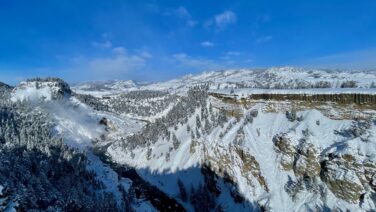
Located just across the brand new bridge over the Yellowstone River, you’ll find the Yellowstone River Picnic Area. Minimally signed, this picnic area is home to one of the more underrated hikes in Yellowstone National Park. This is also one of my most-frequented trails in the park, and no matter what the season, it is worth visiting.
I am recommending it this week for two reasons. One is that the trail is snow-free. The other is that it is a short and relatively easy hike, and one that never disappoints. Best-known for showcasing the unique geology and sweeping views of the canyon, river, and mountains of the northern range, this hike makes for the perfect half-day jaunt. Not only will the views wow you, but you may also see bison, bighorn sheep, eagles, and migratory birds.
The only real difficulty of this trail is the start, which quickly climbs from the picnic area. One secret tip for this hike is to ignore the trailhead to the left of the pit toilet, and instead go to the right, following the boot path up the meadow to the top of the hill. While you totally can hike up the real trail, you’ll be missing some seriously good views by taking the standard route. The boot path route leads to a fantastic, lesser-known view of the canyon and the Yellowstone River, just .2 miles away. Keep this in mind for a quick leg-stretch, if nothing else.
Now, I do want to mention that the picnic area is currently closed. You may be able to park at the pullouts nearby and hike up the trail, but that privilege could be ending any day, once the construction crews return to finish the picnic area remodel. If the pullouts nearby are close, you’ll have to hike this trail from the Specimen Ridge Trail west trailhead, just a mile or so to the east of the picnic area. To do this version of the hike, you’ll follow the Specimen Ridge Trail to the junction, which is about a mile in distance. Please be aware that large herds of bison often frequent the first 3/4 of a mile of this trail, which may require you to walk far around them, off-trail. If this isn’t something you are comfortable with, do not attempt it.
From the junction, you’ll turn right and follow the canyon rim as far as you wish. Make sure you wander around here and take in the views. The sight of the Yellowstone River from here is truly gorgeous. Once you are on the ridge, I’d at least go to the bend of the river by Bumpus Butte, which is about 1.2 miles from the junction.
Follow the trail on the top of the ridge, as best you can. Luckily, the path isn’t complicated, and right now the main source of having to detour will be mud, bison, or bighorn sheep. Stay on the canyon rim. After about a mile from the parking area, you’ll get to one of my favorite views. Here, you’ll get to a bend of the river at the base of Bumpus Butte. You’ll know it’s Bumpus Butte by the steam coming off the base of it where it meets the river. While you could turn around here, going another half mile or so will take you to a spot directly across from the popular Calcite Springs Overlook. To the northeast, which is behind you if you are looking at the river, you’ll get majestic mountain views.
NEXT WEEK
In the next episode, I’ll return with all of the information you need to have a good week in the park, including wildlife, weather, and trail updates. Until then, book a tour with me, pick up a guidebook of mine, and happy trails!