 by
by 
This week in Yellowstone National Park, from January 8th to January 14th, 2026, I will share news about grizzly bear deaths and what is going on with the North Entrance Road. I will also try to convince you to wake up early, look for ravens and magpies, and even share some cool data about how the wolf reintroduction impacted the elk population of Yellowstone. I will also give you the complete weather forecast, the snowpack update, the wildlife report, and everything else you need to have an incredible time, “This Week in Yellowstone.”
LISTEN TO THIS AS A PODCAST
Apple: https://podcasts.apple.com/us/podcast/this-week-in-yellowstone-national-park/id1789397931
Spotify: https://open.spotify.com/show/41E5WWldz4s7n6NXh2Lahr
RSS: https://rss.com/podcasts/this-week-in-yellowstone-national-park/
Disclaimer: I may miss a few details, so please feel free to reach out with any questions. I also mention park locations casually. If you’re unfamiliar, a quick search can help. This report only covers drivable areas of the park.
Also, this podcast is a passion project. If you enjoy it, I’d love a review or a quick email! To support my work, check out my hiking and wildlife-watching guidebooks, or join me for a guided hiking tour in Yellowstone’s backcountry. For more information, visit outdoor-society.com or contact me directly. Seriously though, come book a trail tour with me.
THIS WEEK’S YELLOWSTONE NEWS
YOUR INPUT IS NEEDED IN YELLOWSTONE NATIONAL PARK
The National Park Service (NPS) and Federal Highway Administration (FHWA) are seeking public input on an Environmental Assessment (EA) for rebuilding a permanent North Entrance Road in Yellowstone National Park. This road is a critical corridor, providing year-round vehicle access between Gardiner and Cooke City/Silver Gate, Montana. Public participation will help guide the final decision.
The public comment period is open from January 5 through February 4, 2026. During this time, the public is encouraged to review the EA and submit comments for consideration. All feedback received during the comment period will be evaluated before the NPS makes a final decision in spring 2026.
To support public involvement, the NPS and FHWA will host a virtual public meeting on Wednesday, January 14, from 1:00 to 2:30 p.m. The meeting will include an overview of the project, a presentation of the proposed road options, a video fly-over of the preferred alternative, and a live question-and-answer session. The meeting will be recorded and posted online for those unable to attend live.
The three alternatives for the North Entrance Road. Keep in mind they may be numbered differently:
- Alternative 1: Center Alignment (Preferred Alternative) – Construct a new alignment that uses portions of the original canyon road, convert the temporary road into a multi-use trail, and reclaim damaged sections of the old roadway.
- Alternative 2: OGR Alignment – Re-engineer and widen the temporary road to meet current park road standards and reclaim portions of the old canyon alignment.
- Alternative 3: Gardner Canyon Alignment – Rebuild the original canyon road damaged during the flood and redesign the temporary road as a multi-use trail.
The EA also examines potential impacts to visitor use and experience, wildlife and habitat, water and geologic resources, vegetation and soils, and cultural resources.
The NPS encourages anyone interested in Yellowstone’s future access, infrastructure, and resource protection to review the EA, attend the virtual meeting if possible, and submit comments before February 4, 2026.
GRIZZY BEAR DEATHS
Grizzly bear deaths in the Greater Yellowstone Ecosystem reached a record level in 2025, with roughly 70 to 73 known mortalities, marking the second consecutive year of historically high losses. While the numbers are striking, wildlife biologists emphasize that the causes and what they mean for the population are complex. The majority of these deaths were human-related, reflecting increased overlap between people and a growing grizzly population rather than a sudden ecological collapse.
The largest single category of grizzly deaths in 2025 was livestock conflict. Approximately 20 to 21 bears were killed by wildlife managers after repeatedly preying on cattle, sheep, or other domestic animals. These removals typically occur after non-lethal deterrents fail and are intended to prevent ongoing conflict with ranchers. As grizzlies continue expanding into lower-elevation and human-dominated landscapes, these encounters have become more frequent.
Another major source of mortality involved bears drawn into human-developed areas by attractants such as unsecured garbage, pet food, grain, or hobby livestock. An estimated 16 to 18 bears were killed after becoming food-conditioned or showing behavior that posed risks to people and property. Wildlife officials stress that many of these deaths are preventable through better attractant management.
Vehicle collisions also contributed to the high death toll, with around eight grizzlies struck and killed by vehicles in 2025. As bears move more widely across the ecosystem, often crossing highways and secondary roads, the risk of collisions continues to increase, especially during peak feeding seasons.
A smaller number of deaths were attributed to natural causes, such as age, disease, or environmental stress, with confirmed natural mortalities numbering fewer than ten. In addition, a dozen or so deaths remained under investigation late in the year, with causes not yet determined and potentially including illegal killings.
Researchers with the Interagency Grizzly Bear Study Team note that while mortality numbers are high, they coincide with a large and slowly growing population, estimated at just over 1,000 bears. Still, the data highlight a clear trend: most grizzly deaths in the Greater Yellowstone Ecosystem are tied to human activity. As bears continue to expand beyond park boundaries, reducing conflicts through proactive management may be the key to preventing future record-breaking years.
EXPERIENCE OF THE WEEK
Sunrise or Sunset at Slough Creek
Even though winter is sputtering and not covering the region in full arctic bliss, the experiences one can have are still truly incredible and worth taking a trip into the park. This week, I am recommending one of my time-tested activities that might reward you with lifelong memories.
I know waking up before sunrise sounds like a rough chore, but right now, sunrise will be around 7:50 am at Slough Creek. If you are staying in Gardiner, you can leave your hotel or wherever you are staying at 6:30 and be at Slough Creek around first light. So why should you wake up early? Simply this: wildlife activity, be it howls in the distance or animals roaming, is fantastic at first light and sunrise. When I am in the park at this time, I will stop at a pullout and just listen, more often than not hearing coyotes howling, or maybe even the deep howls of wolves in the distance. I have also seen packs of wolves running near the road, watched as bison shake off the snow and ice that blanketed them overnight, and even spotted foxes listening intently for the scurrying of mice under the snow. The best part is that, depending on where I am, I may be the only person there.
Why Slough Creek? Slough is a time-tested, guide-approved spot for wildlife watching. Not only do you have some good vantage points to scan with binoculars or a spotting scope, but it’s also in a region that has a lot of animal movement all year. It is also a spot that allows you to watch where other vehicles, including wildlife guides, are driving. If nobody is out at Slough, consider going to where they are. However, I want to let you know that just because nobody is there doesn’t mean that the animals aren’t nearby. Last winter, I stopped at a pullout near Slough to do what I am telling you to do, and watched as the wildlife tour cars all raced to Lamar. They ended up seeing nothing, while I watched an entire pack of wolves trot on by in the distance, along the creek and away from where everyone thought they would be. By the time the tour groups arrived, the wolves were out of sight.
If you aren’t a morning person, sunset is obviously the easiest of the two options, as it doesn’t require you to wake up early. However, know that wildlife activity, for whatever reason, is typically less in the late afternoon/early evening. That doesn’t mean nothing will happen; it just means that in my experience, it isn’t as fruitful.
No matter which option you choose, please remember that driving in Yellowstone in the dark requires your full attention. Animals can and will just appear on the road, and often they will be walking on the road. Always drive slowly, be extremely alert, and do not get distracted by your phone or camera.
TIP OF THE WEEK
Look for Scavaging Birds
Looking for birds, especially scavengers, in Yellowstone can add a whole new layer to wildlife watching, and it’s something educators and biologists often encourage. Scavenging birds like common ravens, bald and golden eagles, and black-billed magpies are constantly on the move across the landscape, and they’re tightly connected to what larger animals are doing. Research from Yellowstone’s Wolf Project has shown that ravens are often among the first animals to locate wolf kills, sometimes arriving within minutes to hours. In winter, studies have documented that more than a dozen bird species may feed at a single carcass, with ravens and eagles making up the majority of scavenger activity. For visitors, this means that spotting circling birds, perched eagles, or noisy ravens can be a strong clue that predators or large mammals are nearby, or were very recently.
Over the weekend, I spotted five ravens swooping and flying around when I was driving through Little America. To myself, I said, “I bet there is a carcass up nearby.” Sure enough, I rounded a corner and saw a dozen cars pulled off to the side of the road, all looking to the south. Out in the field, a few hundred feet away, was a dead bison, being eaten by an eagle, a bunch of ravens, and some magpies. A few hours later, when I drove by, a few coyotes were feasting on the ribs of the bison as all of the scavenging birds watched on in hungry jealousy.
From a wildlife-watching perspective, scavenger activity acts almost like a guide to the ecosystem. Biologists estimate that up to 70–90% of a wolf kill can be consumed by scavengers over time, especially during colder months when carcasses last longer. This creates predictable hotspots where multiple species gather, increasing the chances of seeing birds, mammals, and interactions between them in one place. Instead of randomly scanning for elusive predators, experienced observers often watch the sky first; birds soaring low, repeatedly landing, or calling excitedly can point to important ecological events unfolding on the ground.
Scavengers also help explain why Yellowstone is such a productive place for wildlife viewing compared to many other areas. Because the park still supports large predators, there is a steady supply of carrion that sustains birds year-round. In a handful of documents from the National Park Service, it is said that the availability of food supports higher numbers of eagles and ravens than in surrounding regions, especially in winter when prey animals are more vulnerable. For visitors, this means that even when mammals are hard to spot, scavenging birds can still provide clear evidence of an active, functioning ecosystem, as well as a potential indicator that predators may be around.
In a more practical sense, watching scavenger birds helps people understand that wildlife viewing isn’t just about dramatic chases or rare sightings. It’s about reading the landscape. When you notice where birds are gathering and how they’re behaving, you’re seeing the connections between life, death, and survival in real time. That awareness not only improves your chances of seeing wildlife but also deepens your understanding of how Yellowstone works as a living system, one where nothing is wasted, and every species, including scavengers, plays an essential role.
RANDOM YELLOWSTONE FACT OF THE WEEK
A Very Brief History of the Elk Population in Yellowstone, Regarding Wolves
When people talk about elk in Yellowstone, one question always seems to come up: Did wolves cause elk numbers to crash? The real story is far more interesting and far more complex.
Today, I am going to be briefly talking about the Northern Yellowstone elk herd, one of the most closely studied wildlife populations on the planet, and what decades of research actually tell us about predators, climate, and survival. The source I am using for this is a paper titled: NORTHERN YELLOWSTONE ELK RESILIENCE & ADAPTATION to Changes in Management Policies and the Ecosystem. Please know that this is a very brief and quick summary, and if you are interested in this topic, I strongly suggest you read the whole thing.
Link: https://www.nps.gov/yell/learn/nature/upload/ELK-BOOK-FOR-WEB_accessible.pdf
Let’s start with some history. In the early 1900s, elk numbers across the American West were low after decades of unregulated hunting. Yellowstone National Park became a refuge, and once predators like wolves and cougars were eliminated, elk numbers rebounded quickly.
By the mid-20th century, the Northern Yellowstone elk herd often exceeded 15,000 animals. At the time, this was widely viewed as a conservation success. But there was a downside. With no major predators, elk spent long periods browsing willow, aspen, and cottonwood, especially along rivers and streams. Over time, those plants struggled to regenerate.
Park managers responded by actively reducing elk numbers through culling and removals. This approach lasted for decades and reflected the belief that humans needed to carefully control wildlife populations to protect the landscape. By the late 1960s and 1970s, that philosophy began to change. Yellowstone adopted a management approach known as natural regulation. Instead of directly controlling elk numbers, the park would allow weather, food availability, and predators to shape the population.
That shift became especially important in the mid-1990s, when gray wolves were reintroduced to Yellowstone after nearly 70 years of absence.
After wolves returned, elk numbers declined, but wolves were not acting alone. Several severe winters in the late 1990s and early 2000s played a major role. Deep snow and prolonged cold dramatically increase the energy elk need just to survive, while also limiting access to forage.
Research consistently shows that winter severity is one of the strongest predictors of elk population change. In harsh winters, calf survival drops, and adult elk, especially older individuals, are more likely to die. In milder winters, survival improves.
Nutrition is another critical piece of the puzzle. Elk depend on high-quality summer forage to build fat reserves. Those reserves determine whether cows become pregnant and whether they can successfully raise calves the following spring. When summer conditions are poor, fewer calves survive, regardless of predator numbers.
Predation adds another layer. Wolves tend to prey on calves and older, weaker elk, especially during winter. Cougars hunt elk year-round, often in forested terrain. Grizzly bears and black bears are major predators of newborn calves in spring and early summer.
What’s important to understand is that no single predator accounts for most elk deaths. Instead, mortality is spread across multiple predators and seasons. This shared pressure creates a more stable system and influences elk behavior as much as it affects numbers.
Elk today move differently across the landscape than they did decades ago. They spend less time lingering in risky areas like open valley bottoms and riparian zones. This shift has had visible effects on vegetation.
In some areas of the Northern Range, willows and aspens have begun to recover, improving habitat for birds, beavers, and other species. In other areas, recovery has been limited by factors like soil conditions, hydrology, climate, and browsing by bison. Yellowstone scientists caution against simple cause-and-effect explanations, emphasizing that ecological change is complex and highly variable.
By the 2010s and early 2020s, the Northern Yellowstone elk herd generally stabilized between 4,000 and 6,000 animals. While this is lower than mid-century highs, research shows this level is consistent with the ecosystem’s current conditions.
Today, Yellowstone managers focus on monitoring rather than manipulating elk numbers. The goal isn’t to maximize elk populations; it’s to maintain a resilient, functioning ecosystem where predators, prey, weather, and vegetation interact naturally.
So when people ask whether wolves caused elk to decline, the best answer is this: wolves are part of the story, but they’re only one chapter. The full story is about balance, adaptation, and what happens when natural processes are allowed to shape a landscape.
WEATHER FOR THE COMING WEEK
Apple: https://podcasts.apple.com/us/podcast/this-week-in-yellowstone-national-park/id1789397931
Spotify: https://open.spotify.com/show/41E5WWldz4s7n6NXh2Lahr
RSS: https://rss.com/podcasts/this-week-in-yellowstone-national-park/
SNOWPACK UPDATE
As of January 7th, the snowpack is around 120% of normal for this time of year. Last year on this date, we were averaging around 80% of our normal level.
ROADS CONDITIONS
The only road open is the road between Gardiner, Montana, and Cooke City, Montana. Please be aware that this road can close at any time due to inclement weather.
For up-to-date information, call (307) 344-2117 for recorded information, or sign up to receive Yellowstone road alerts on your mobile phone by texting “82190” to 888-777.
CAMPING INFO
There is only one campground open in the park right now, and that is the Mammoth Campground, which is open year-round.
WILDLIFE WATCHING UPDATE
You have to listen to the podcast to get this information. Sorry.
Apple: https://podcasts.apple.com/us/podcast/this-week-in-yellowstone-national-park/id1789397931
Spotify: https://open.spotify.com/show/41E5WWldz4s7n6NXh2Lahr
RSS: https://rss.com/podcasts/this-week-in-yellowstone-national-park/
PICK UP A GUIDEBOOK
Love what you have heard on this podcast and want more information on wildlife watching? Get a copy of my wildlife-watching guidebook to the region! Available in both ebook and paperback formats, my book will help you spot wildlife like a seasoned local. Please consider buying a book directly from me, as I make next to nothing when they are sold on Amazon. Grab your copy now at outdoor-society.com!
TRAIL ALERTS AND UPDATES
There are no official trail alerts this week. Always carry bear spray, have it readily accessible, and know how to use it.
Honestly, the snow in much of the park is pretty awful, which makes recommending anywhere to go snowshoeing less than ideal. I know that new snow has fallen since last weekend, but we still need more before snowshoeing really gets good.
TREK OF THE WEEK
Lost Lake and Lost Creek Falls View.
The trail to Lost Lake and the upper viewpoint of Lost Creek Falls are often overlooked, much like many other trails I feature in my guidebook. While the Petrified Tree area remains a popular destination, few individuals venture beyond the well-trodden paved path, and fewer still in the winter.
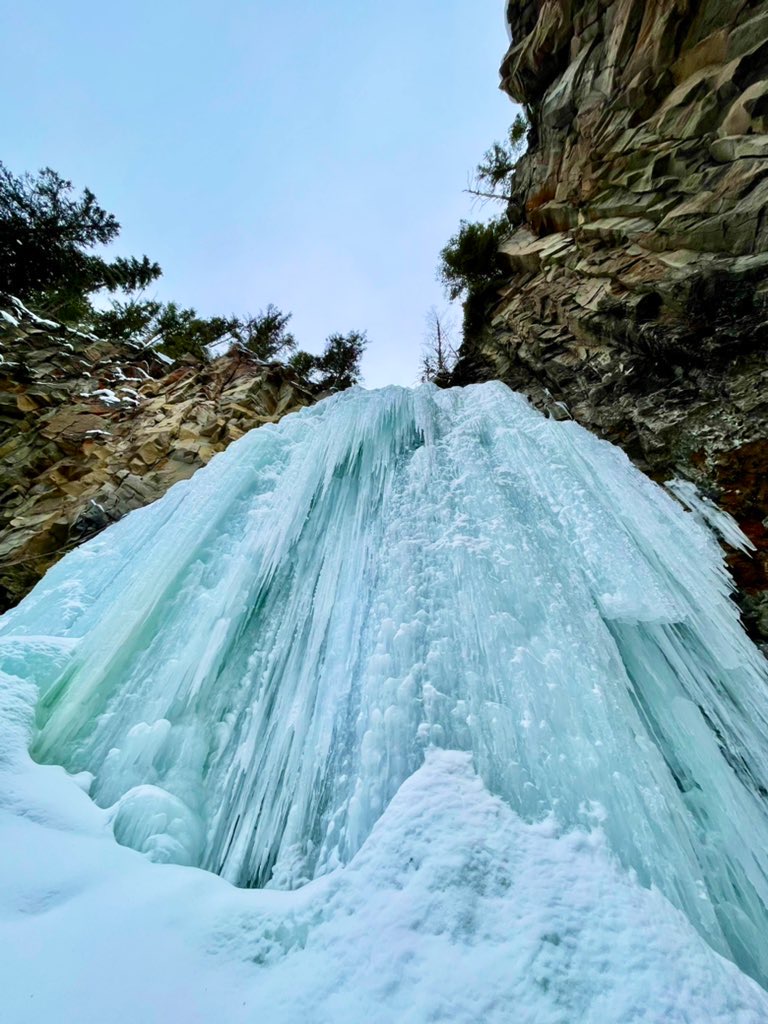
However, those who do make their way to the caged tree in the winter months have an opportunity to expand their adventure and step off the beaten track to experience the tranquility of Lost Lake, along with the breathtaking view of the frozen-over Lost Creek Falls. More people seem to be going to Lost Lake in the winter, but the view of the falls remains a trek that is rarely wandered on snowshoes.
The trail to the lake is extremely easy to follow, passing through a narrow gap between hills before arriving in an open area that houses the lake. In the winter, the lake is frozen and covered in snow, creating a wide open expanse for you to wander and look for animal tracks. I have seen most of the major animal tracks here in the snow, including wolves. It is little wonder why this route is gaining in popularity.
Beyond the lake, the trail crosses a quaint little bridge over the creek, enters a forest, and darts toward the top of the canyon. Keep your expectations of walking atop a canyon low, as the forest keeps it mostly hidden as you traverse around it. After crossing another small bridge over the creek, you’ll head along the opposite side of the canyon. The trees remain, but more glimpses of the canyon begin emerging to your left. Keep an eye out for clearings as you near the end of the canyon. From a few spots, you’ll be able to walk short boot paths to the canyon rim and see the majestic Lost Creek Falls. Be cautious of cornices on the canyon rim, as the drop will probably kill you. While I say this in all seriousness, if you stay away from the edge, you’ll be perfectly safe.
This is a 5.5-mile out-and-back trek in the winter with about 200 feet of elevation gain and loss. Please contact me if you’d like more information on this route or if you’d like to take a snowshoe tour with me here.
Or, you can pick up a copy of my hiking guidebook, Beyond the Boardwalks: Yellowstone National Park, and find your perfect hike in the region. Please consider buying a book directly from me, as I make nothing when they are sold on Amazon.
NEXT WEEK
In the next episode, I’ll return with all of the information you need to have a good week in the park, including wildlife, weather, and trail updates.
Until then, book a tour with me, pick up a guidebook of mine, and happy trails!