 by
by 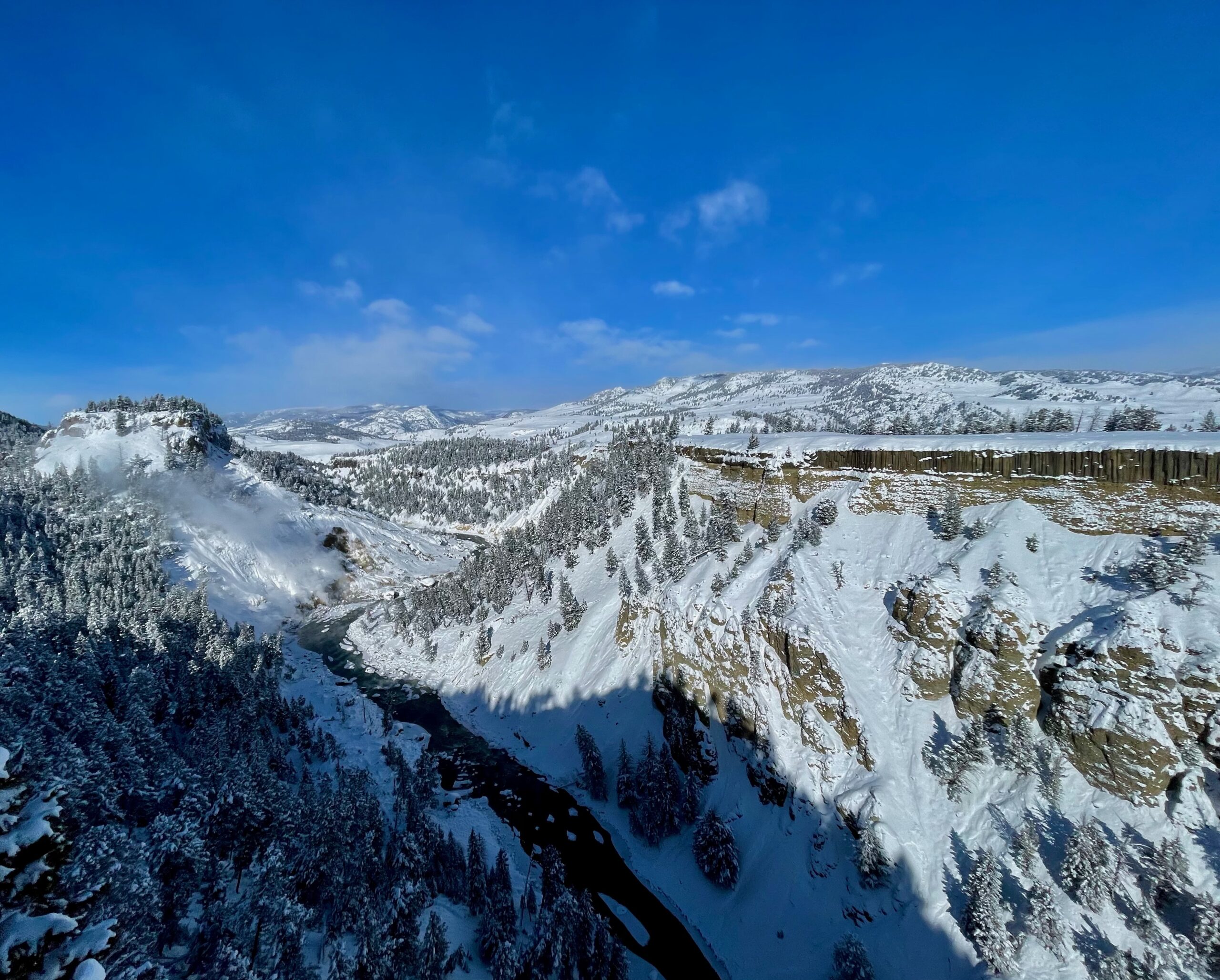
This week in Yellowstone National Park, from January 1st to January 7th, 2026, I will share one of my favorite winter snowshoe destinations, tell you to go off the beaten path, and let you know how many wolves are in the park. I will also describe what the park is like in January so you can be ready for your trip. I will also give you the complete weather forecast, the snowpack update, the wildlife report, and everything else you need to have an incredible time, “This Week in Yellowstone.”
LISTEN TO THIS AS A PODCAST
Apple: https://podcasts.apple.com/us/podcast/this-week-in-yellowstone-national-park/id1789397931
Spotify: https://open.spotify.com/show/41E5WWldz4s7n6NXh2Lahr
RSS: https://rss.com/podcasts/this-week-in-yellowstone-national-park/
Disclaimer: I may miss a few details, so please feel free to reach out with any questions. I also mention park locations casually. If you’re unfamiliar, a quick search can help. This report only covers drivable areas of the park.
Also, this is a passion project. If you enjoy it, I’d love a review or a quick email! To support my work, check out my hiking and wildlife-watching guidebooks, or join me for a guided hiking tour in Yellowstone’s backcountry. For more information, visit outdoor-society.com or contact me directly.
THIS WEEK’S YELLOWSTONE NEWS
GUIDE VEHICLES STOPPING IN THE ROAD
Over the holiday season, an article came out from a Wyoming newspaper talking about a guide service stopping on the road for wildlife viewing. The incident was first discussed on a Facebook page, from an anonymous poster, so you know it quickly spiraled into a cesspool of finger-pointing, blaming, and over-the-top insults and rhetoric. Why the newspaper decided to report on it is anyone’s guess…psst, it’s because negativity drives engagement and engagement fuels ad revenue.
Now, why am I talking about this now? Plain and simple, blaming one guide service over another for this is silly. Every driving tour company I have seen operating in the park has violated this rule dozens of times a year. Same with hundreds of photographers with permits to operate in the park. While it is true, I went on a few small rants about stopping on the road last year, I also gave a way to report the behavior and tried to not single anyone out. Stopping on the road will happen. It is inevitable. However, we can all work better to make sure we are not the ones doing it. Never stop in the road, always use pullouts, and be the park visitor you want others to be. Lead by example.
Also, if you do see a guide company stopping in the road, report them. Take a picture of their vehicle and license plate, document the location, time, and date, and let a ranger at the visitor center know. The company will probably be lectured by the park, and if they continue to display bad behavior, they may lose their operating license.
EXPERIENCE OF THE WEEK
Pebble Creek Canyon
There are so many awesome and unique places in Yellowstone National Park that the majority of visitors have no idea of their existence. My experience of the week this week is one of those spots. Now, before I share how to get there, I want to make one thing very clear. This is not a secret spot at all. It is just one of those places not on the map and flyer you get when entering the park, which is why it is largely overlooked. Also, this experience will require you to get out of the car and into the cold, so do not attempt it unless you have good clothing for an hour or so outside, and warm socks and durable winter boots.
Now that we have that all out of the way, this week, I am hoping to convince you to get out to Pebble Creek Canyon. Located a short trek in the snow from the old Pebble Creek Campground, this adventure leads you into a frigid and frozen canyon, showing off huge rock walls, cool ice features, some animal tracks in the snow, and a hidden cave. To reach the cave and back from the pit toilet parking area, you’ll travel a mile total and gain around 75 feet in elevation. It is mostly flat and pretty easy, if you have good shoes and everything is frozen.
Once parked and layered up, walk around the gate to the campground, and there should be a beaten-down and decently traveled path in the snow to follow. If there isn’t, work your way to the campground, staying near the creek. Once at the end of the campground along the creek, you’ll stay to the left of the creek almost the entire time, working your way next to logs, sometimes over them, and along the snow-covered and frozen creek. You’ll then round a corner and get into a huge canyon with towering walls on either side. Enjoy this view, as it is a pretty special place. From there, keep heading upstream, through another narrow section, and into another more open spot. This is where the cave will be. The cave is located on the other side of the creek, and if it is safe to cross, do it! I often will enter this cave and just hang out for a bit. If crossing the creek to the cave looks sketchy at all, do not do it. Be smart and safe.
While you can continue upstream beyond the cave, there isn’t much there. The canyon narrows more, and it gets steeper. Instead of trying to keep going, turn around at the cave and walk back the way you came.
TIP OF THE WEEK
What to Expect When Visiting Yellowstone in January
Visiting Yellowstone National Park in January requires planning and realistic expectations. This is the heart of winter in the park, and access, transportation, and weather are all very different from the summer season.
In January, most of Yellowstone is closed to personal vehicles. The only road open to regular cars is the route between Gardiner and Cooke City, passing through Mammoth Hot Springs and Lamar Valley. This road is plowed, but often snow-covered or icy, and drivers should not expect bare pavement. All other park roads are closed and inaccessible by car.
Because of these closures, the only way to reach the park’s interior, including places like the Grand Canyon of the Yellowstone, Old Faithful, and other thermal areas, is by guided snowcoach or snowmobile tour. These oversnow vehicles operate on groomed routes and require reservations. If visiting the geyser basins or the Canyon area is a priority, booking a tour is essential.
The weather is a major factor in January travel. Temperatures are consistently cold, with average daytime highs between 24°F and 28°F (-4°C to -2°C) and overnight lows commonly between 0°F and 5°F (-18°C to -15°C). Subzero temperatures are very possible, especially at night and during cold snaps. Wind and snowfall can further increase cold exposure and affect visibility. I will continue to do my best to bring you the weather forecast, so you can be as well-prepared as possible.
Services are limited during this time of year, compared to the summer. Only a small number of lodging and dining options remain open, primarily at Mammoth Hot Springs and Old Faithful Snow Lodge. Visitor centers may have reduced hours, and fuel, food, and medical services inside the park are minimal. With options limited, many visitors choose to stay outside the park and enter for day trips. Spots in Gardiner, Silver Gate, and Cooke City are your best bet for quick entry to the park if you are heading into the northern range with your own car.
January is also one of the best times for wildlife viewing, particularly in the northern range, where bison, elk, moose, coyotes, and wolves are more visible against the snow and tend to move more during daylight hours than they do in the warmer months. Be aware that wildlife, especially bison, often use packed roads and valleys to travel, so visitors should be prepared for slow driving and frequent stops.
For those hoping to hit the trails in January, you’d better bring snowshoes or cross-country skis. Hiking trails will be covered in a lot of snow, and groomed ski trails are extremely limited. Because of this, winter trail adventures are only for the hearty and experienced. However, there are ways to have a good time on trails in the winter; you can book a snowshoe tour guide like yours truly. If you do not have snowshoes or cross-country skis, you can still take a few treks, but please do not walk in areas designated for snowshoe and cross-country traffic only. The upper Mammoth terrace loop trail is one of those areas where people in just boots are not allowed. Also, never walk in boots on ski paths or snowshoe paths. Your footsteps in just boots will ruin the ski tracks.
Overall, January comes with strict access limitations, cold temperatures, and fewer services. Visitors who plan ahead, dress appropriately, and understand the transportation requirements will be better prepared for a safe and successful winter visit.
RANDOM YELLOWSTONE FACT OF THE WEEK
2025 and Historic Wolf Populations
Before the holiday break, I attended a day of classes for guide training. While I could talk at length about that, I instead wanted to share some information I learned that day about the current wolf population in Yellowstone.
As of the most recent count, there are 87 wolves within the boundary of the park. 54 of them are in the northern range, and 33 are in the rest of the park. 68 of the wolves are adults, and 19 are pups. For those who want the pack breakdowns, you are in luck.
In the northern range, there are four known packs. They are the 8-mile, Rescue Creek, Junction Butte, and Bliss Pass packs.
The 8-mile has 17 wolves, 9 adults, and 8 pups.
The Rescue Creek has 16 wolves, 12 adults, and 4 pups.
The Junction Butte has 15 wolves, 9 adults, and 6 pups.
The Bliss Pass has 6 wolves, all adults.
In the non-northern range packs, there are four groups. They are the Cougar Creek, The Mollie’s, The Wapiti Lake, and the 1470F group.
Cougar Creek has 4 members, all adults.
The Mollie’s have 9 members, 8 adults and 1 pup. Interesting about the Mollie’s is that they had a lot more pups this year, but all of them but one died. Disease is suspected.
Wapati Lake has 18 members, all adults.
The 1470F group has two members, both adults.
For those curious, the 87 wolves in the park are the lowest number since 2018, when just 80 wolves roamed the park. In 2023, there were 124 wolves, and in 2024, there were about 120. Interestingly, hunting outside the park played very little role in the reduction of the wolves, with most deaths coming from natural causes, if you count wolf-on-wolf violence natural, which it is.
WEATHER FOR THE COMING WEEK
I am too lazy to type it out, so you need to listen to the podcast to get it.
Apple: https://podcasts.apple.com/us/podcast/this-week-in-yellowstone-national-park/id1789397931
Spotify: https://open.spotify.com/show/41E5WWldz4s7n6NXh2Lahr
RSS: https://rss.com/podcasts/this-week-in-yellowstone-national-park/
SNOWPACK UPDATE
As of December 10th, the snowpack is around 120% of normal for this time of year. Last year on this date, we were averaging around 80% of our normal level.
ROADS CONDITIONS
The only road open is the road between Gardiner, Montana, and Cooke City, Montana. Please be aware that this road can close at any time due to inclement weather.
For up-to-date information, call (307) 344-2117 for recorded information, or sign up to receive Yellowstone road alerts on your mobile phone by texting “82190” to 888-777.
CAMPING INFO
There is only one campground open in the park right now, and that is the Mammoth Campground, which is open year-round.
WILDLIFE WATCHING UPDATE
You have to listen to the podcast to get this information. Sorry.
Apple: https://podcasts.apple.com/us/podcast/this-week-in-yellowstone-national-park/id1789397931
Spotify: https://open.spotify.com/show/41E5WWldz4s7n6NXh2Lahr
RSS: https://rss.com/podcasts/this-week-in-yellowstone-national-park/
PICK UP A GUIDEBOOK
Love what you have heard on this podcast and want more information on wildlife watching? Get a copy of my wildlife-watching guidebook to the region! Available in both ebook and paperback formats, my book will help you spot wildlife like a seasoned local. Please consider buying a book directly from me, as I make next to nothing when they are sold on Amazon. Grab your copy now at outdoor-society.com!
TRAIL ALERTS AND UPDATES
There are no official trail alerts this week. Bears are still out, so always carry bear spray, have it readily accessible, and know how to use it.
TREK OF THE WEEK
Calcite and Tower
The snowshoe up to Tower Fall and Calcite Springs is a classic winter adventure in Yellowstone National Park and one that you should not skip. It is one of my favorites and an experience that will help you love Yellowstone in the winter even more. With the road to Tower Fall closed in the winter at the junction at Roosevelt, the only way to reach the stunning views once the road is closed for the season is on foot, more often than not in snowshoes.
Tower Fall and Calcite Springs are beloved roadside jaunts in the summer months, but reaching them in the winter is truly special. Long gone are the full parking lots and paths bustling with activity. They have been replaced with a peacefulness and serenity that warms the heart and soul on the coldest of days.
Even when driving this short section of road in the summer, one can’t help but be dazzled by the views. When on foot, you get even more time to appreciate the sights, sounds, and smells of the area. Thats right! In the winter, the sulfur smell from Calcite Springs can be quite strong, giving you whiffs of the thermal feature from far away. I suppose that could be considered a lowlight to some, but come on, it is Yellowstone!
For me, the main highlight of this trek is the Calcite Springs Overlook. Don’t get me wrong, seeing Tower Fall from the viewing area, frozen and blue against the exposed rocky towers for which the area was named, is stunning. I just think the view from Calcite is even more stunning. At Calcite, the panoramic view will have you seeing steam rising from the bottom of Bumpus Butte, with the Yellowstone River flowing gorgeously far below your feet. You’ll see examples of millions of years of geology and volcanic activity across the river, giving you access to the past against impossibly steep canyon walls. To the east, towering mountains rise to meet the sky, and along the canyon rim, you may catch a glimpse of bison, elk, or bighorn sheep grazing.
Between Calcite and Tower, the road levels off, and you’ll get to walk along the canyon rim. On one side will be stunning rock formations. On the other hand, sweeping views of the Yellowstone River and the surrounding landscape. This is legitimately one of the most stunning roadside stretches in all of Yellowstone, and in the winter, you get to take your time and walk it, soaking it all in. Then, when you peel yourself away from the grand vista, you’ll get to walk over the bridge spanning Tower Creek and look at the incredible designs caused by freezing temperatures.
Once you reach Tower, the parking lot will be empty, the store will be closed, and there may be bison roaming nearby. Make sure none are on the trail and head down the short path to the overlook. At the overlook, enjoy the beautiful view of the frozen waterfall and rocky pillars. It is definitely more than fine if you love this view more than Calcite Springs.
The wildlife sightings on this trek can also be quite good if one is lucky. You can see bison nearly every time and occasionally see bighorn sheep, moose, coyotes, foxes, elk, and even signs of wolves. While I have yet to see a wolf here, I have heard them howl and have spotted fresh tracks in the snow multiple times each year.
Everyone who has an interest in a winter adventure outside in Yellowstone. This is a classic trek and one that dazzles nearly all who wander it. Just know that you’ll be traveling five miles round trip, with roughly 500 feet of elevation gain. You’ll also be starting at over 6,000 feet above sea level.
If you have never snowshoed and are interested in doing it, please strongly consider booking a private tour with me. I even provide the snowshoes.
Tower Fall and Calcite Springs is a fantastic snowshoe adventure for nearly all levels of outdoor enthusiasts. I have seen families with kids do this, and multiple generations of family members make the trek. The road is wide and not too steep in any section and is even occasionally groomed, making it a go-to spot for snowshoers, cross-country skiers, and those looking for an easier outdoor adventure.
NEXT WEEK
In the next episode, I’ll return with all of the information you need to have a good week in the park, including wildlife, weather, and trail updates.
Until then, Happy New Year and happy trails!