 by
by 
This week in Yellowstone National Park, from November 13th, through November 19th, 2025, I will let you know why you should be excited about the colder, wetter weather in the forecast, share a “secret” waterfall in Lamar Valley, give tips on how to see mountains goats, and even try to get you to hike a remote suspension bridge over the Yellowstone River. It is probably not the one you are thinking it is. I will also give you the complete weather forecast, the snowpack update, the wildlife report, the news, and everything else you need to have an incredible time, “This Week in Yellowstone.”
LISTEN TO THIS AS A PODCAST
Apple: https://podcasts.apple.com/us/podcast/this-week-in-yellowstone-national-park/id1789397931
Spotify: https://open.spotify.com/show/41E5WWldz4s7n6NXh2Lahr
RSS: https://rss.com/podcasts/this-week-in-yellowstone-national-park/
Disclaimer: I may miss a few details, so please feel free to reach out with any questions. I also mention park locations casually—if you’re unfamiliar, a quick search can help. This report only covers drivable areas of the park.
Also, this podcast is a passion project—I’m not paid or sponsored. If you enjoy it, I’d love a review or a quick email! To support my work, check out my guidebooks on hiking and wildlife watching, or join me for a guided Yellowstone tour. For more information, visit outdoor-society.com or contact me directly.
EXPERIENCE OF THE WEEK
Watching Winter Maybe Actually Start, Possibly
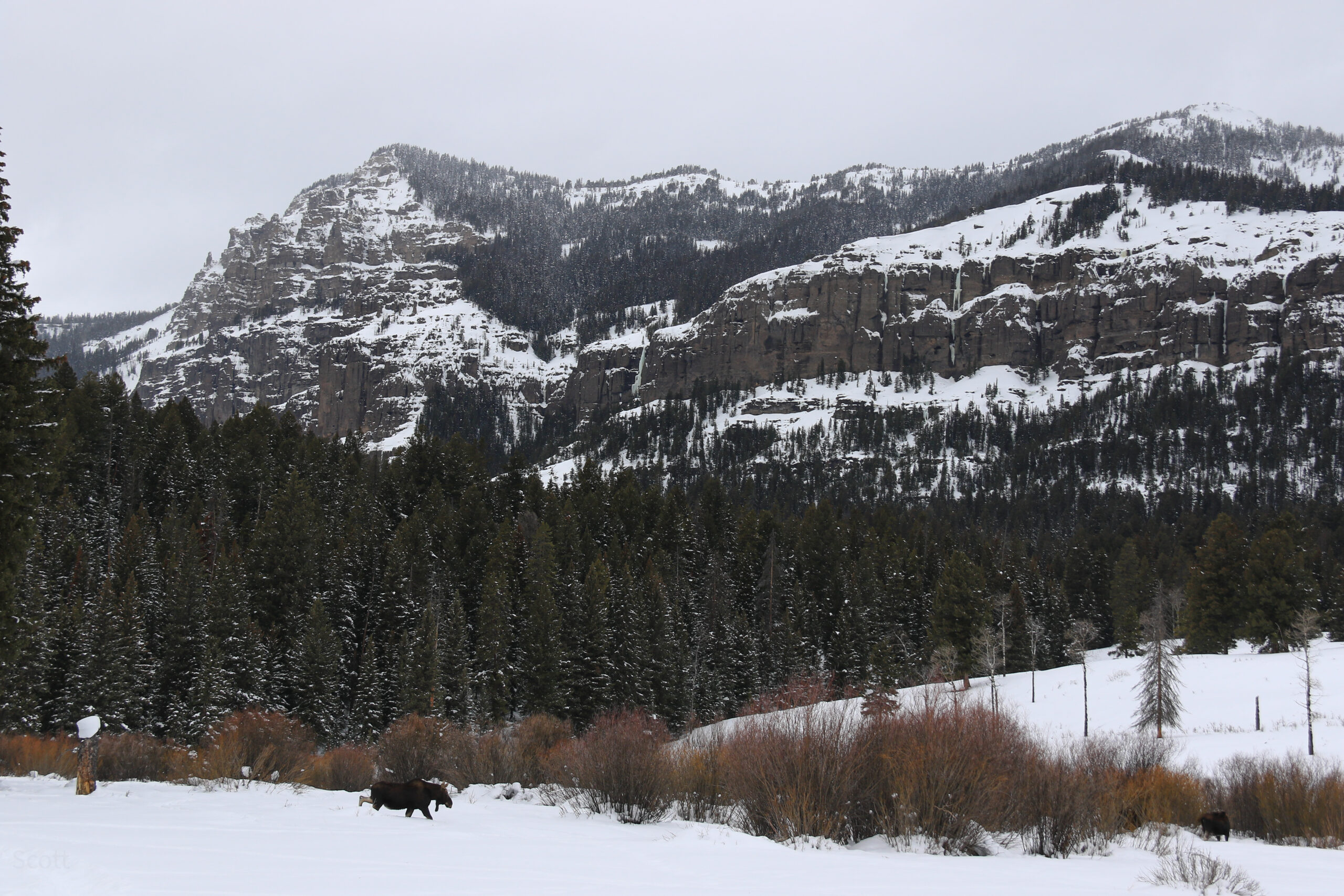
After a few spurts and teases, just like sitting and waiting for an Old Faithful eruption, it appears like winter weather, or at least real fall weather, is going to be coming to Yellowstone National Park. I’ll go into the details of the weather forecast in the weather section of this episode, but the gist is this: Colder, wetter, snowier weather is anticipated for this weekend and the coming week. Now, this isn’t going to be some epic storm that dumps feet of snow on all of us. Instead, it is a return to “normal,” whatever that means.
As I type up this report, it is 66 degrees in my community just north of the park, far too warm and balmy for November. There is snow on the mountains, but only a little, and people are walking around in shorts and t-shirts. There is a chill in the air in the evening, but it honestly feels like May out here. Which is not good. It should be frigid. That is why, looking at the forecast, I and many of my fellow locals are excited.
If you do find yourself in the park this week, you get to hopefully watch the final transitional period between warm weather and the colder temperatures and snowier days we need out here. If you are visiting this week, you’ll have more clouds, some rain, and maybe even some snow falling across the landscape. Again, it isn’t going to be a serious and worrisome winter storm. Just more seasonally appropriate weather.
When this time of the year rolls around, I like to be in the park as it starts to shift. Seeing the darker clouds on the western horizon, heading toward me as the wind picks up and the temperature drops, is about as primal a feeling as one can have. I sincerely hope it starts to actually snow in the park this week, with flakes falling on the handful of cars driving between Cooke City and Gardiner, transforming the landscape.
Now, how is this an experience for the week? Well, since you will be in the park on less-than-perfect weather days, I want you to know how good it is to have this weather. Being in the park for a transition between warm days and cold is always memorable. The animals may be moving to lower ground and could be more active. The mountains will get whiter with snow and become more dynamic and dramatic. If enough snow falls, footprints of wildlife will be visible in every corner of the park, letting you see how active the landscape truly is. You’ll also have a chance to walk on trails, be it long or short, as snowflakes potentially come tumbling down, sticking on the summer growth of the sage. The cold and wet will not only dampen the landscape but also the sounds of the region, giving you a true sense of quiet in the wilds of the park.
It may sound like I am saying to make lemonade out of lemons, but days like the ones in the forecast this coming week are some of my favorites, as they seem to end on a chapter and start a new one, giving us hope and excitement for what is to come this winter.
If you want to know what parts of the park I enjoy on days like this, feel free to reach out to me, and I can direct you to some cool areas, both roadside stops and hiking trails, long and short.
TIP OF THE WEEK
How to See Mountain Goats In Yellowstone in November
Mountain goats might look right at home on Yellowstone’s rugged cliffs, but they actually don’t belong there. According to the National Park Service, these sure-footed climbers are not native to the Yellowstone ecosystem. They were introduced into the nearby Absaroka and Madison mountain ranges in the 1940s and 1950s, primarily for hunting and recreational purposes. Over the decades, a few goats wandered into the park, and by the 1990s, a small breeding population had taken hold in Yellowstone’s northeastern and northwestern corners (NPS, 2024). Surveys from the early 2000s estimated around 100 to 200 goats living within the park, and the discovery of young “kids” confirmed they were successfully reproducing there (NPS History, 2004).
While mountain goats are a popular sight for visitors, biologists are keeping a close eye on their impact. The Wildlife Society notes that, as nonnative animals, goats could compete with native species like bighorn sheep for alpine vegetation and territory, potentially affecting the park’s delicate ecosystem (Wildlife.org, 2019).
If you’re hoping to spot these white-coated climbers, there’s one place that consistently delivers: Barronette Peak. Located near Yellowstone’s Northeast Entrance, the mountain rises above the Lamar Valley corridor and offers some of the best goat-viewing opportunities in the park. From the roadside pullouts, you can scan the high cliffs and rock faces with binoculars or, better yet, a spotting scope; the goats’ bright white coats often stand out against the dark volcanic rock (Yellowstone Explored). Many visitors describe Barronette as a “prime location” for viewing these agile animals, especially during the quieter morning and evening hours when the light is softer and the wildlife tends to be more active.
Photographer Jim Coda recommends bringing high-powered optics since the goats rarely come close to the road, preferring to stay hundreds of feet up on the cliffs (JimCoda.com). For the best luck, focus your search on the east- and south-facing slopes of the mountain. These areas warm up first during the day and often draw goats looking for exposed vegetation or mineral licks (Biology Insights). Patience is key; it can take a while to spot movement on the rocks. Watch for flashes of white, slow climbing, or small groups perched near ledges.
One wildlife enthusiast on MammalWatching.com described spending hours scanning the cliffs before finally spotting several goats moving across the face of Barronette Peak, calling it “one of the most rewarding sightings” of their Yellowstone trip (Mammal Watching Report, 2024).
Because the terrain is so steep, you’ll usually be watching from a distance, which is ideal for both your safety and the animals’. Use the pullouts along the highway, and avoid hiking directly toward cliffs or steep scree slopes. These goats are built for the vertical world, but we’re not!
Seeing mountain goats in Yellowstone feels like discovering one of the park’s best-kept secrets. Their presence may be controversial from an ecological standpoint, but there’s no denying the awe of watching a pure white goat effortlessly scale a jagged wall of stone. If you’re traveling through the park’s northeast corner, take a little extra time to stop at Barronette Peak, set up your scope, and scan the cliffs. With a bit of luck and a lot of patience, you might catch a glimpse of these nonnative, but fascinating, alpine wanderers.
RANDOM YELLOWSTONE FACT OF THE WEEK
The Waterfall in Lamar Valley
Lamar Valley is world-famous. Even if people don’t know the name for sure, they know the area, thanks largely to the wolf reintroduction that took place 30 years ago. Even before that, the valley was a thing of beauty and a well-known spot to see elk, bears, bison, bighorn sheep, coyotes, otters, badgers, and pretty much every type of wildlife in Yellowstone. Each year, over a million people flock to the area, often giving them an unforgettable experience watching the animals of the park. With dozens of pullouts spread throughout the valley, one can pretty much see every nook and cranny of the region, helping the valley earn the nickname, “America’s Serengeti.”
Despite Lamar Valley being an incredible and popular place, there are still secrets and hidden spots that only a handful of people know of. This week, I am sharing one of those. Now, before I share it, I know that some will say that sharing locations like this will ruin them. Firstly, thanks for greatly overestimating the reach of this. Secondly, the spot I am mentioning used to be a popular spot for original park visitors, falling by the wayside for more grand areas. Finally, this spot can be seen with binoculars or a spotting scope from a pullout, or is only reached after a long hike off-trail, through the backcountry full of bears, bison, and other wildlife.
The place? Fairies’ Fall. Now, I know what you are thinking. I know Fairy Falls. It is a popular waterfall and hike in the Geyser Basin. You are right. Fairy Falls is a popular waterfall and hike near Grand Prismatic. That is Fairy Falls. This is Fairies’ Fall.
Fairies’ Fall is a waterfall in Lamar Valley that, if you know where to look, you might just see it. You can also see it on my “Off the Beaten Path Lamar River” hiking tour, which I cannot recommend enough.
The following is an excerpt from “Yellowstone Place Names” by Lee H. Whittlesey: Fairies’ Fall- This 30-foot waterfall is located about one-half mile from the mouth of Amethyst Creek. In about 1880, photographer Henry Bird Calfee appears to have given this beautiful plural possessive name to the waterfall…” The excerpt continues: “In 1883, writer Herman Haupt Jr. used the name in his park guidebook, apparently confident that visitors would see the falls using the tourist trail which passed just north of the falls along the south bank of the Lamar River.
Obviously, Fairies’ Fall never captured the hearts of visitors to the park. Despite Herman Haupt Jr.’s best efforts, other waterfalls and features took priority for those seeing Lamar Valley, and the falls eventually became forgotten. Today, anyone searching for information on Fairies’ Fall will be inundated with information on Fairy Falls, but nothing on this waterfall in Lamar Valley. The only information I could easily find on this was from a video game called Wolf Quest, which is a simulator game of the wild wolves of Yellowstone National Park. Other than that, it is listed in the book I referenced earlier and in very few other locations.
So, where exactly is Fairies’ Fall? If you stop at the pullout south of the Buffalo Ranch in Lamar Valley, you’ll potentially be able to see it. You want to look across the valley for a stand of evergreen trees, a little set back on the other side of the river. You’ll have cottonwoods on your side of the river, and to the right of them will be the evergreens. It is in the evergreens, most bunched up right along the shoreline, where Fairies’ Fall sits.
Next time you are in Lamar, stop at the pullout and look across the way, locate it, and point it out to those who are with you. Let them know that the falls had once been beloved enough to be mentioned in a guidebook in the 1880s, but today, only a few of us know about it.
If you’d like to see Fairies’ Fall, contact me and I will happily hike out there with you. The hike I lead to get there is roughly 11 miles with 1500 feet of gain and is full of bones, antlers, skulls, and experiences you get nowhere else in Yellowstone. You’ll definitely want to take it if you want to really know Lamar Valley.
SNOWPACK UPDATE
As of November 4th, the snowpack is 75% of normal for this time of year. Last year on this date, we were at 75% of our normal level.
ROADS CONDITIONS
The only road open is the road between Gardiner, Montana, and Cooke City, Montana. Please be aware that this road can close at any time due to inclement weather.
For up-to-date information, call (307) 344-2117 for recorded information, or sign up to receive Yellowstone road alerts on your mobile phone by texting “82190” to 888-777.
CAMPING INFO
There is only one campground open in the park right now, and that is the Mammoth Campground, which is open year-round.
WILDLIFE WATCHING UPDATE
You have to listen to the podcast to get this information. Sorry.
Apple: https://podcasts.apple.com/us/podcast/this-week-in-yellowstone-national-park/id1789397931
Spotify: https://open.spotify.com/show/41E5WWldz4s7n6NXh2Lahr
RSS: https://rss.com/podcasts/this-week-in-yellowstone-national-park/
PICK UP A GUIDEBOOK
Love what you have heard on this podcast and want more information on wildlife watching? Get a copy of my wildlife-watching guidebook to the region! Available in both ebook and paperback formats, my book will help you spot wildlife like a seasoned local. Please consider buying a book directly from me, as I make next to nothing when they are sold on Amazon. Grab your copy now at outdoor-society.com!
TRAIL ALERTS AND UPDATES
There are no official trail alerts this week. Bears are still out, so always carry bear spray, have it readily accessible, and know how to use it.
TREK OF THE WEEK
Blacktail Deer Creek Trail
If you’re looking for a Yellowstone hike that still feels wild and quiet in November, the Blacktail Deer Creek Trail is hard to beat. This trail winds through open meadows, dips into forested draws, and eventually drops down to the Yellowstone River, where a suspension bridge gives you one of those “wow” moments that make the effort totally worth it. Round-trip, it’s about 8 miles with roughly 1,100 feet of elevation change, according to the National Park Service. It’s a solid half-day hike, not too long, not too short, giving you a real taste of the park’s backcountry.
The trail starts off in the Blacktail Plateau area, following a short hill up through gentle sage meadows where you may see elk or bison grazing. These meadows stretch out with big sky views and crisp air that feels extra sharp as winter approaches. In the early morning when it is below freezing, the sage may have a thin layer of ice on it, adding to the beauty. After about a mile or so, the trail begins to descend, following Blacktail Deer Creek through stands of fir and juniper. In the fall, the light filtering through the trees has that soft, golden glow, and with almost no other hikers around this time of year, it’s easy to forget about everything but the day. This is one of the reasons why I am recommending it this week.
Eventually, the trail starts to drop a little steeper, and you’ll start to hear the Yellowstone River before you see it. The deep, echoing sound gets louder with each step, teasing you with the calming soundtrack. When you finally break out above the river and step onto the suspension bridge, it’s a breathtaking view. The river cuts through the Black Canyon, framed by rugged slopes and potentially streaks of snow this time of year. If you’re lucky, you might spot bighorn sheep on the cliffs, bison roaming, elk strolling, or a bald eagle flying above the water. This part of the trail feels worlds away from the road, and in November, it’s often just you, the wind, and the sound of the river. At the suspension bridge, you have a few options. You can just hang out here for a bit and then hike back, or you can add some distance and have a longer adventure. A half-mile from the bridge is Crevice Lake, and roughly a mile and a half from the bridge is a chance to reach Knowles Falls, a cascade along the Yellowstone River that pretty much nobody ever sees. Just know that no matter what you choose, you have to hike back, and it’s pretty much all uphill.
One of the best parts about hiking this trail in late fall is the isolation. Since the trek is roughly an 8-mile round trip and will have over 1,000 feet of elevation gain, few will hike this. Since it is isolated, you may see signs of some of the more uncommon wildlife to see on hikes. Wolf tracks sometimes appear along the trail, and it’s not rare to find signs of bears digging before they enter torpor. While many will assume that the bears are gone now, black bears and grizzlies are still around, so it’s smart to carry bear spray, make noise as you hike, and travel in a group whenever possible.
Now, if you’re going to give this trail a go, start early, as the days are short and the temperatures drop fast once the sun dips. Bring layers, plenty of water, and maybe a thermos of something warm for a break by the river., Hiking down to the bridge and back gives you a unique view of the Yellowstone River in Yellowstone’s northern range.
This week, Blacktail Deer Creek Trail will offer everything that makes hiking in Yellowstone special: solitude, sweeping views, wildlife potential, and that quiet sense of awe that comes when the crowds are gone and winter is just around the corner. It’s a reminder that even after the roads start to close, there’s still a lot of magic waiting on the trail.
NEXT WEEK
In next week’s episode, I’ll return with all of the information you need to have a good week in the park, including wildlife, weather, and trail updates.
Until then, happy trails!