 by
by 
This week in Yellowstone National Park, from November 6th, 2025, through November 12th, 2025, I will talk about the bighorn sheep rut, let you know about the ground under Mammoth, share a trail to get to a remote beach on the Gardner River, and so much more. I will also give you the complete weather forecast, the snowpack update, the wildlife report, the news, and everything else you need to have an incredible time, “This Week in Yellowstone.”
LISTEN TO THIS AS A PODCAST
Apple: https://podcasts.apple.com/us/podcast/this-week-in-yellowstone-national-park/id1789397931
Spotify: https://open.spotify.com/show/41E5WWldz4s7n6NXh2Lahr
RSS: https://rss.com/podcasts/this-week-in-yellowstone-national-park/
Disclaimer: I may miss a few details, so please feel free to reach out with any questions. I also mention park locations casually—if you’re unfamiliar, a quick search can help. This report only covers drivable areas of the park.
Also, this podcast is a passion project—I’m not paid or sponsored. If you enjoy it, I’d love a review or a quick email! To support my work, check out my guidebooks on hiking and wildlife watching, or join me for a guided Yellowstone tour. For more information, visit outdoor-society.com or contact me directly.
THIS WEEK’S YELLOWSTONE NEWS
The Price of a Bear Sighting
A new study by researchers at the National Park Service and the U.S. Geological Survey estimates that each grizzly bear in Yellowstone National Park contributes about $46,000 annually to the park’s economy through visitor sightings. That figure translates to roughly $8.7 million per year overall from grizzly bear viewing. In contrast, black bears are estimated at around $15,000 annually per animal, amounting to about $6.9 million total for their sightings.
The study uses survey data of visitor travel costs and viewing experiences to calculate these values, though the authors emphasize this only reflects “use value” (actual sightings) and not the full “intrinsic value” of the animals. Some wildlife advocates caution against applying dollar values to wild creatures, calling the approach “simplistic” and reminding us the bears’ worth isn’t just financial.
EXPERIENCE OF THE WEEK
November and December are when the bighorn sheep’s mating season occurs around Yellowstone National Park. If you haven’t witnessed it and are heading to the park in the next month, you’ll get a chance to see this seasonal ritual.
There is nothing quite like seeing two bighorn sheep rams slam their horned heads against each other. As they turn and twist their heads, getting ready for impact, a stillness fills the air before a deafening crack echoes off the cliffs from the hard heads crashing together. They may repeat the battle a few times, or one ram will be victorious and the loser walks or runs away. The winner will then continue, hoping to get a chance to mate with the ewe that he has been following around for countless hours.
Where can you watch this all happen?
The best spot to see it right now is along Old Yellowstone Road, between Yellowstone Hot Springs and Gardiner. Witnessing the bighorn sheep mating season is one of those events that, for many, is once-in-a-lifetime. Those of you fortunate enough to have seen it should still see it again, as it is something that changes year to year. Watching the bighorn sheep rut continuously gives a unique glimpse into the relationships that bighorn sheep have with each other. Breeding timing and behavior are well documented for the region; mating typically begins in mid to late November.
During mating season, you’ll see the rams battle. Competition ranges from tricky circling and vocal displays to full-on collisions: when two big rams clash, their massive curled horns can meet at speeds of up to 40 mph, and the impact is spectacular and loud. These contests sort dominance hierarchies and determine which males get to mate.
You’ll watch them chase ewes up and down hillsides. You’ll witness rams kicking both rams and ewes to keep them in line. You’ll also see long chases, rams “testing” ewes, face-to-face posturing, and the occasional head-butt. Much rut behavior is surprisingly theatrical; rams may parade around, circle, lip-curl, and lock eyes before a bout, and sometimes several males will gang up on a single receptive ewe. You’ll probably even get a glimpse of rams and ewes mating. So be ready to see a bighorn sheep penis or two.
Some may shirk at that last sentence, but honestly, you won’t want to miss this. If you are heading to the park this week, or even just in the area, I can’t suggest seeking out some bighorn sheep sightings enough. From large congregations of sheep on hillsides to a few burly-looking rams battling it out, this is a great time to visit and one that is sure to provide some incredible, and potentially graphic, memories and pictures.
One of the most consistent locations over the last few years to see the bighorn sheep battles and mating is located outside the park, near Yellowstone Hot Springs, off of Highway 89. Right now, this is the absolute best place to see the bighorn sheep rut. As of November 1st, a few rams have made their way down to the larger herd of ewes, signalling that the rut is afoot. The ewes are already congregating in large numbers near the dirt road. I spotted 50 of them the other day, and that was only one group. The three big rams were interested, but not yet aggressive with their action, choosing to hang out together instead of viewing each other as rivals. This will change any day now, and it is why I am suggesting you go and look at them now.
I am also suggesting this now because once the action picks up fully, the relaxed watching of the sheep turns into any other wildlife viewing event in and around the park. Tour groups will take their vans to the spot, with dozens of photographers spilling out and lining the road. Non-toured photographers will also be battling for position along the road, and often stay in the area from sunrise to sunset in hopes of that perfect shot. For now, though, the vibe is very relaxed.
I do want to let you know that while this spot is outside of the park, please adhere to appropriate wildlife watching rules and regulations. Stay 25 yards from them, as best you can. The rams will run around a lot, chasing ewes. Do not stray too far from your car and always give the sheep plenty of space. You will see tour groups and other photographers getting way too close. Let them be dumb. Because rams are focused on females, they are often less concerned by cars, which means they will run right at you without a second thought. They are drunk off desire and will move you if you are in their way.
Also, be aware that the rams will battle and do not care if your car is nearby. Every year, I have had rams fighting off in the distance, from the car, and within seconds, I have had to quickly move when one ram attacked another and pushed it within inches of the vehicle. Again, definitely stay in your car and keep it on and ready to move so you don’t suffer some serious damage from aggressive bighorn sheep. Finally, if you do head here to watch the sheep, please pull off the road and be aware of people driving back and forth. There are residents in this area who need to get by, as this is a real road.
TIP OF THE WEEK
Watch the Bison’s Tail
A bison’s tail can tell you a lot about what’s going on in its mind, and understanding those signals is important, especially in places like Yellowstone, where encounters can happen at close range. When a bison is relaxed, its tail typically hangs low and loose while it grazes. The Buffalo Bill Center of the West notes that “a calm bison’s tail hangs low and relaxed,” and that this is one of the easiest ways to recognize when the animal isn’t stressed. But a high tail is a very different message. According to the same source, “if its tail is up in the air like a flag, it’s on high alert and might charge,” which is why wildlife experts warn that a raised tail is a sign to back away and give the animal space.
Scientific research backs this up. A behavioral study of wood bison, a close subspecies, found that tail position correlates strongly with activity and social behavior. In that research, tail-up or horizontal postures were most often associated with aggression, dominance displays, alert behavior, and sexual activity, while relaxed grazing behavior came with the tail hanging low or gently wagging. The study also found that dominant bulls in aggressive encounters displayed tail-up postures more often than their rivals, indicating a link between tail elevation and assertive or potentially dangerous behavior.
Wildlife safety educators reinforce this interpretation. As one source explains, a raised or partially raised tail can be an early sign of agitation or potential attack, especially if paired with other warning behaviors like staring, head swinging, snorting, or pawing the ground. Together, these signs suggest the animal is deciding how to respond and may escalate if approached or pressured. The Buffalo Bill Center emphasizes that when a bison locks eyes with you and raises its tail, you are already inside its comfort zone and should back off immediately.
In the field, all of this means one thing: if you see a bison’s tail shoot upward or stiffen horizontally, treat it as a serious warning. Even a seemingly gentle tail-flick can turn into a full flag-raise in seconds, and bison are capable of charging without further cues. Conversely, a low, loose tail that swings naturally usually means the animal is feeding or moving calmly, but that doesn’t mean it’s tame or safe to approach. The National Park Service and wildlife experts consistently stress that tail position is just one clue, but a very reliable one, and the safest choice when a tail rises is always to give the animal more space.
In short, think of the tail as one of Yellowstone’s simplest safety signals. A relaxed tail means peace. A raised tail means business. And if that flag goes up, you move back, fast, calm, and without waiting to see what happens next.
RANDOM YELLOWSTONE FACT OF THE WEEK
The “Hollow Ground” at Mammoth Hot Springs
Mammoth Hot Springs is renowned for its tiered white-and-orange travertine terraces, living sculptures formed by hot, mineral-rich water that both carves and builds the landscape. Hidden beneath that beauty is a dynamic subsurface world of dissolved limestone, migrating vents, and voids that park staff and early builders long ago said that the area was sitting on “hollow ground.” Understanding that hollow ground explains why parts of Mammoth can feel fragile, why boardwalks and fences are essential, and why the terraces are always shifting.
The story starts with water. Snow and rain seep into the surrounding high country, sink deep, and are heated by Yellowstone’s geothermal system. As hot water circulates through buried Paleozoic limestone and dolostone, it dissolves calcium carbonate and carries bicarbonate-rich fluid toward the surface. When that fluid reaches the air, carbon dioxide degasses (like opening a fizzy drink), the pH rises, and calcium carbonate precipitates as travertine, the chalky white rock of the terraces. Over thousands of years, this process has built Terrace Mountain and the broad Mammoth formations we see today.
That deposition is fast by geological standards: recent measurements put travertine growth at Mammoth at rates on the order of millimeters per day in active places, much faster than many comparable carbonate systems. Rapid building at the surface can therefore hide what is happening below: groundwater pathways move, conduits enlarge as limestone dissolves, and voids can form where formerly solid rock has been removed by chemical action.
“Hollow” is a descriptive phrase used historically at Mammoth to refer to subsurface voids, unstable sediments, thermal conduits, and shallow collapse features that can underlie otherwise solid-looking terraces and grounds, especially across the Parade Ground and near older, inactive terraces. In some areas, rapid travertine deposition has built a crust over softer, dissolving materials; in others, the plumbing that brings hot water to the surface shifts its discharge point and leaves behind weakened or empty spaces. The result: localized sinkholes, depressions, and the sense that the ground is “hollow.” Early fort builders noted this problem when Fort Yellowstone and hotel foundations were planned. Early expeditions slept on the ground, and when their horse moved, they swore the ground beneath them was hollow too.
Mammoth’s thermal system is fed in part by a corridor of flow that extends from the hotter Norris Geyser Basin; underground faults and a fractured rock network channel water toward the limestone that supplies dissolved carbonate. Because the system is fracture-controlled and sensitive to pressure and chemical changes, vents open and close, springs migrate, and flows can stop in one place and start in another, sometimes over days, sometimes over decades. Small earthquakes and the continual flexing of the rock also help to keep the fractures open, so thermal activity and the location of springs are not static. Those shifts contribute to the formation of new travertine in one spot and subsidence or hollowing in another.
The hollow ground is why Yellowstone manages visitor access carefully at Mammoth. Boardwalks, overlooks, and fenced zones keep people off fragile terraces and away from areas where subsurface instability or sudden thermal changes could be hazardous. It’s also why historical buildings in the Mammoth area were built with an awareness of ground instability; fenced sinkholes and caves remain visible reminders of how active processes can undercut seemingly firm ground. Scientists monitor Mammoth’s thermal outputs and terrace growth because changes on the surface often reflect changes in the subsurface plumbing.
The hollow ground under Mammoth Hot Springs is not a defect so much as a symptom of a vigorous, ongoing geologic process: carbonate rocks are being dissolved, mineral-charged waters are moving and depositing travertine, and the ground is adjusting to those changes. That dynamism is what makes Mammoth unique: terraces that grow, die back, and regrow; sinkholes that tell a tale of removed rock; and a landscape where visible beauty records invisible chemical and hydrologic activity beneath your feet. For visitors, the result is a place of fragile splendor: breathtaking terraces to view from safe paths, and an underground story that keeps geologists and park managers watching closely.
SNOWPACK UPDATE
As of November 4th, the snowpack is 84% of normal for this time of year. Last year on this date, we were at 55% of our normal level.
ROADS CONDITIONS
The only road open is the road between Gardiner, Montana, and Cooke City, Montana. Please be aware that this road can close at any time due to inclement weather.
For up-to-date information, call (307) 344-2117 for recorded information, or sign up to receive Yellowstone road alerts on your mobile phone by texting “82190” to 888-777.
CAMPING INFO
There is only one campground open in the park right now, and that is the Mammoth Campground, which is open year-round.
WILDLIFE WATCHING UPDATE
You have to listen to the podcast to get this information. Sorry.
Apple: https://podcasts.apple.com/us/podcast/this-week-in-yellowstone-national-park/id1789397931
Spotify: https://open.spotify.com/show/41E5WWldz4s7n6NXh2Lahr
RSS: https://rss.com/podcasts/this-week-in-yellowstone-national-park/
PICK UP A GUIDEBOOK
Love what you have heard on this podcast and want more information on wildlife watching? Get a copy of my wildlife-watching guidebook to the region! Available in both ebook and paperback formats, my book will help you spot wildlife like a seasoned local. Please consider buying a book directly from me, as I make next to nothing when they are sold on Amazon. Grab your copy now at outdoor-society.com!
TRAIL ALERTS AND UPDATES
As of November 1st, all interior trails will be off-limits, unless you hike to them from the nearest closed gate. That leaves only the northern range trails available for easy access. Please note that higher elevation trails will have snow on them, and appropriate gear and clothing will be needed. The Yellowstone River Overlook trail is open, but you’ll need to follow the signs and park to the east of the regular trailhead. Other than that, enjoy hiking!
TREK OF THE WEEK
The Lava Creek Trail to the Gardner River
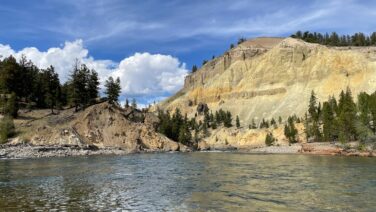
Located just east of Mammoth Hot Springs, the Lava Creek trail is a favorite of mine for this time of the year. Before it gets snowy and harder to traverse, the Lava Creek Trail is a perfect hike for those looking for cool views, a unique view of a well-known waterfall, and a chance to sit along the Gardner River far from anyone else. It is also not a popular hike at all, thanks to some elevation loss and gain, giving those seeking true solitude exactly that.
Right now, you have to start the Lava Creek trail up by the Lava Creek picnic area. The bridge down by the Mammoth Camoground washed away in 2022, and while it was supposed to be fixed this year, it was not. But that is ok. It means that the trail is even less visited, especially this time of year. After parking at the picnic area, you’ll want to walk across the road, then across the bridge over Lava Creek. There will be a small path to your left. Follow that, and after you climb a tiny hill, you’ll see the trail marker and the well-maintained trail.
Follow the trail for a little less than a half-mile, and you’ll get to the first feature. Take the bootpath on the left and you’ll soon be standing on top of Undine Falls. Usually seen from the parking area across the canyon, the view of Undine Falls from here is incredible. Stay on the bootpath around the canyon rim, taking in great views of Lava Creek and Mammoth in the distance. Once you meet the main trail, start heading down.
Honestly, the trek down isn’t the most amazing or scenic thing for a mile or so. Sure, you’ll take in some decent views, but it isn’t until about the two-mile mark that things start opening up in full grandeur. Along the lower hill section, keep an eye out for bones, antlers, and skulls. There is a bison carcass, well-picked over, located down here. You’ll also have some pretty awesome views of the bridge spanning the Gardner River, giving you a unique view of this architectural gem.
From here, follow the trail all the way down to the Gardner River. About three and a half miles from the trailhead, you’ll find a rocky beach you can hang out on. I usually have lunch here and just hang out, watching for birds and other wildlife, while sitting along a section of the river that few ever see. Once you have had your fill, you get to hike back up the hill.
Overall, you’ll gain over 1,000 feet in elevation in a little over two miles, giving you a good workout after the leisurely stroll down to the river. When I do this, my watch reads about 7 miles in total distance and 1,200 feet of total gain.
NEXT WEEK
In next week’s episode, I’ll return with all of the information you need to have a good week in the park, including wildlife, weather, and trail updates.
Until then, happy trails!