 by
by 
This week in Yellowstone National Park, from February 5th to February 11th, 2026, I try to encourage you to drive to Cooke City, tell you what you need to have a good wolf watching day, share the story of Yankee Jim Canyon, and tell you about a scenic hike to the Yellowstone River, just outside of the park. I will also give you the complete weather forecast, the snowpack update, the wildlife report, and everything else you need to have an incredible time, “This Week in Yellowstone.”
LISTEN TO THIS AS A PODCAST
Apple: https://podcasts.apple.com/us/podcast/this-week-in-yellowstone-national-park/id1789397931
Spotify: https://open.spotify.com/show/41E5WWldz4s7n6NXh2Lahr
RSS: https://rss.com/podcasts/this-week-in-yellowstone-national-park/
Disclaimer: I may miss a few details, so please feel free to reach out with any questions. I also mention park locations casually. If you’re unfamiliar, a quick search can help. This report only covers drivable areas of the park.
Also, this podcast is a passion project. If you enjoy it, I’d love a review or a quick email! To support my work, check out my hiking and wildlife-watching guidebooks, or join me for a guided hiking tour in Yellowstone’s backcountry. For more information, visit outdoor-society.com or contact me directly. Seriously though, come book a trail tour with me.
EXPERIENCE OF THE WEEK
Head All The Way to Cooke City
For some of you, this is a no-brainer. Since there is only one open road in the park, it makes sense to drive from Gardiner to Cooke City and back. However, more and more I am seeing people drive to Soda Butte or Pebble Creek, and then turning around to head back to Lamar and then to Mammoth. Those who do this miss out on some fantastic mountain scenery, a potential for wildlife like foxes and moose, and a chance to grab a cup of coffee or a snack in a tiny town surrounded by snowy mountains.
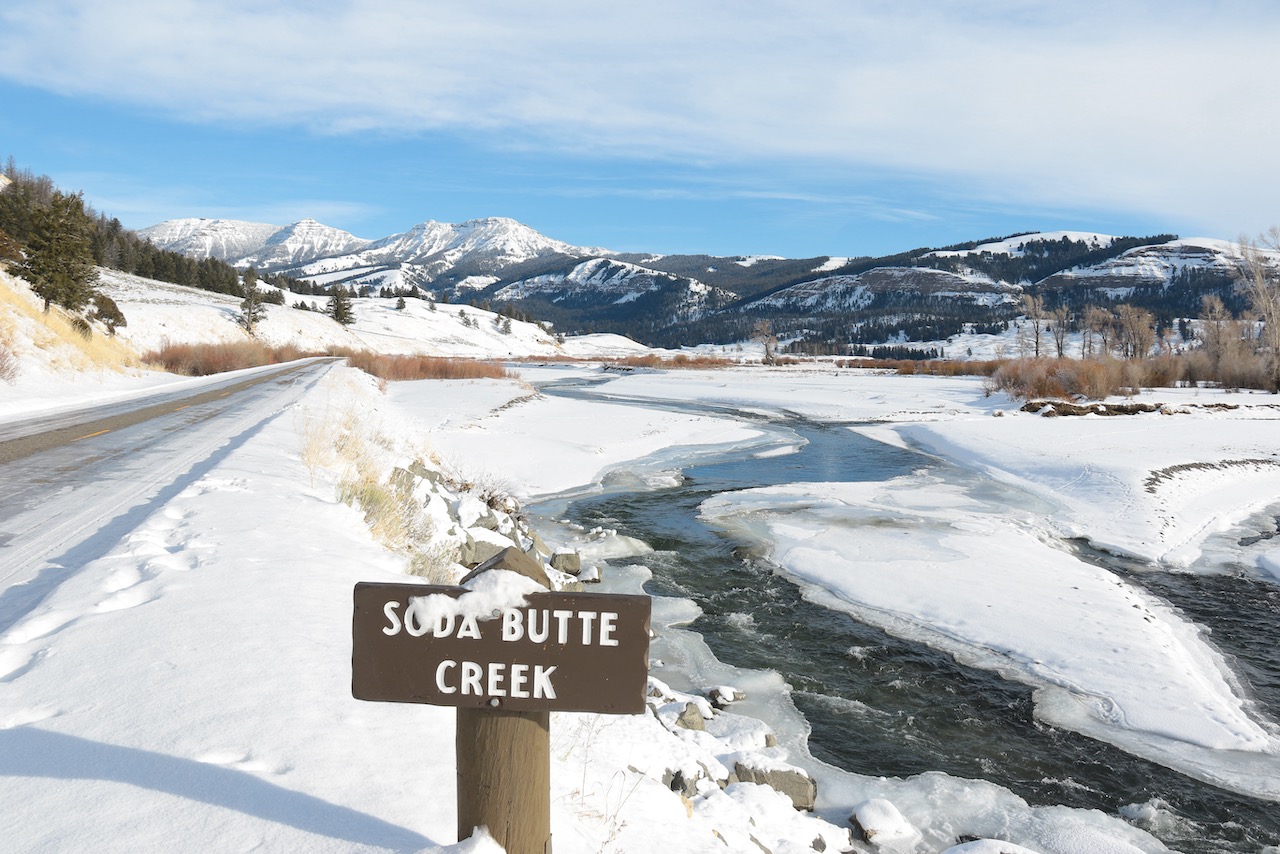
Once past Pebble Creek, the landscape begins to shift. Snow piles deeper, trees press closer to the pavement, and visibility for wildlife drops compared to Lamar’s open valleys. The road narrows slightly as it skirts Ice Box Canyon and follows Soda Butte Creek. As you climb, Barronette Peak dominates the view on your right, its sheer face lined with frozen waterfalls in winter. Be sure to stop at the Barronette Peak Overlook on the north side of the road. With binoculars or a spotting scope, patient viewers can sometimes spot mountain goats tucked among the cliffs and ice, nearly invisible unless you know where to look. At the very least, you’ll see dozens of frozen waterfalls.
Continuing toward Cooke City, the scenery opens up again as you near the Northeast Entrance. After exiting the park, the views to the south expand dramatically, with snow-covered ridgelines stacking into the distance. It’s easy to get distracted by the mountains, but keep an eye on the lower meadows as well. This stretch is excellent moose habitat, and winter sightings are surprisingly common.
You’ll pass quickly through Silver Gate, which is largely closed up in winter. A few places may be open, but the town mostly sleeps until summer. Just beyond it, pull into the parking area near the Mt. Republic Chapel for one of the best views in the area. Republic Mountain rises sharply above Cooke City, gaining more than 2,600 feet in just a mile. Known historically as Republic Peak, the mountain’s name was officially changed to Republic Mountain in 1959, but its imposing presence hasn’t changed at all.
As you roll into Cooke City, watch along Montana Street, where foxes are frequently spotted in winter. If you’re lucky enough to see them, park in town and walk back to observe from a safe distance rather than stopping in the roadway. Once in Cooke City, wander into a shop, stop by the visitor center, which has a small museum and the town’s only public restroom, and take a moment to appreciate the literal end of the road. I also recommend a stop at Cooke City Coffee, as they make a good drink and have good snacks. Let them know you heard of them from this podcast, and maybe they will give me a free drink or something.
Once you have wandered the town, which should only take 20 minutes or so, take your time as you head back. Look for moose, foxes, and other wildlife. Enjoy the mountain views, read the historic signs, and revel in the remoteness. Driving to Cooke City and back allows you to discover a different side of Yellowstone in winter, and maybe even encourages you to stay there on your next visit.
TIP OF THE WEEK
Want to See Wolves? Have Binoculars and/or A Spotting Scope
If you’re heading to Yellowstone’s northern range this winter, forget about animals prancing up to your car window. Sure, pictures on social media may make it seem like you’ll have plenty of up-close-and-personal sightings of wildlife in the park, but the reality is that animals may be far away. Sure, you will probably see bison, elk, and deer close to your car window, but animals like wolves are generally pretty far away. That’s where binoculars or a spotting scope become essential, not optional.
Even when animals are easier to see thanks to the snow cover, they’re rarely close. Wolves in particular are long-distance subjects. In Slough Creek, Hellroaring, and Lamar Valley, a few of the best wolf-watching places in the world, wolves are often hundreds of yards to a few miles away. Now, I know what some of you are thinking. Plenty of people see wolves much closer than this and have gotten some amazing pictures. You may have had a closer encounter than that yourself.
Both of these things can be true, but those close experiences are outliers and very rare. The most common wolf sightings will be around a half mile to a mile away, if not more. I often tell people I can see a wolf nearly every day in the park, but I quickly say that more often than not, the wolves are a few miles away. Without a spotting scope or a good pair of binoculars, there is a good chance you’ll be standing out with everyone, unable to see the wolves that they all see.
So what optics should you bring? For most visitors, a good pair of binoculars in the 8×42 or 10×42 range is ideal. These models balance bright, sharp views with ease of handheld use, especially in winter’s low light. An 8×42 tends to be easier to hold steady and offers a wider field of view, while a 10×42 gives you more magnification to pick out detail on distant ridges. Many seasoned northern-range watchers prefer a compact travel pair (8×32) for quick scanning and a larger pair for serious glassing later.
If you want to go deeper, a spotting scope (20–60× or 25–75×) mounted on a lightweight tripod is a game-changer. Scopes give you high magnification and clarity that binoculars alone can’t match, ideal for watching wolves and any other animal far off in the distance. Most guides set up a scope at classic vantage points so everyone in their tours gets a close look without disturbing wildlife. That is because they are in the park every day and know that scopes are routinely needed to give people a closer view of the little specks in the distance.
Using optics also aligns with Yellowstone’s ethic of safe, respectful viewing. Getting too close can force animals to flee or, at the very least, disturb their behavior, which causes them to potentially burn precious calories they otherwise need to survive. Binoculars and scopes let you appreciate the moment without compromising animal welfare or park rules.
Access to the northern range amplifies the value of optics. Scanning with optics turns popular scenic pullouts into world-class wildlife watching locations. They bring the action to you, despite being so far away that you can’t see anything with your naked eye.
The good news is that even if you don’t own binoculars or a spotting scope, that’s not a deal-breaker; rentals are easy to find in gateway towns like Gardiner. A quick search on your favorite search engine can give you the name and location of these stores. Or you can also reach out to me, and I can tell you places I know that rent gear like this. Either way, have binoculars and/or a spotting scope when you are in the park. You will definitely regret not having it if you are going to the park for wildlife watching.
RANDOM YELLOWSTONE FACT OF THE WEEK
Who is Yankee Jim of Yankee Jim Canyon Fame?
Yankee Jim Canyon is a narrow, rugged stretch of the Yellowstone River about 10 miles north of Gardiner, Montana. Named after James “Yankee Jim” George, a legendary frontier character born in Vermont in 1841, the canyon was a natural barrier to travel in the 1870s and played an important role in early access to the Yellowstone region.
Yankee Jim arrived in Montana in the early 1860s and tried his hand at hunting, trapping, and prospecting before turning his attention to transportation through the wild Yellowstone valley. Around 1871, he took over an existing wagon road through the canyon that had been built a couple of years earlier by Bart Henderson and Adam “Horn” Miller to link gold fields and early settlements with Mammoth Hot Springs. Jim improved the route and, in 1873, declared it the National Park Toll Road, establishing a cabin and toll booth where travelers heading south to the newly created Yellowstone National Park had to pay to pass. He famously charged different rates for stock, reportedly a nickel per cow and a dime per sheep, because he “hated sheep.”
Yankee Jim’s personality became as legendary as his toll road. Known as a gifted storyteller, he entertained early tourists with tall tales of bear hunts, confrontations with wolves, and frontier exploits. His reputation grew to national notice; it’s said that when President Theodore Roosevelt was visiting the Yellowstone area in 1902–1903 and heard about Yankee Jim, he wanted to meet him. An officer was sent to deliver an invitation, but Jim coolly replied that Roosevelt “knows where I live,” and would need to come find him. According to local lore, Roosevelt took him up on that challenge, rode out to Yankee Jim’s cabin, and spent the afternoon trading stories, an iconic picture of frontier humor meeting executive power. Whether literally true or embellished with time, the tale captures the spirit of both men and the era.
Jim’s toll road business thrived until 1883, when the Northern Pacific Railroad extended a branch line through the canyon to reach Corwin Springs. Jim reportedly resisted, but the railroad eventually built its route by negotiating (or, in some accounts, tricking Jim) him into relinquishing control of the canyon road. Park County formally bought the route in 1893 for $1,000, ending Jim’s control. Jim lived out his later years mostly on his ranch and died in 1924 at about age 94.
Today, Yankee Jim Canyon is best known not for toll booths but for its dramatic scenery and recreation opportunities. The canyon is short, less than five miles long, but it is carved through steep, boulder-strewn walls where the Yellowstone River cuts a twisting course. These rapids are among the largest on the Yellowstone outside of the national park, making the canyon a favorite destination for whitewater rafters and kayakers in late spring and early summer. Multiple outfitters run trips, and the river’s wild character makes it an exciting stretch for experienced paddlers.
Access to Yankee Jim Canyon is easy from U.S. Highway 89, which follows the Yellowstone River north from Gardiner. Several pullouts and roadside viewing points along the highway offer good views of the canyon’s rock walls and river flows. Anglers also frequent the calmer stretches upstream and downstream for trout fishing, and nearby local roads once used as railbeds and stage routes offer access for hikers and history buffs.
Because of its combination of geologic drama, transportation history, and frontier lore, Yankee Jim Canyon remains a compelling stop for travelers exploring the Yellowstone gateway, a place where human stories and wild river energy converge along one of the region’s most iconic waterways.
WEATHER FOR THE COMING WEEK
I am too lazy to type it all out, so you’ll have to listen to the podcast to get the weather forecast, or just contact me.
Apple: https://podcasts.apple.com/us/podcast/this-week-in-yellowstone-national-park/id1789397931
Spotify: https://open.spotify.com/show/41E5WWldz4s7n6NXh2Lahr
RSS: https://rss.com/podcasts/this-week-in-yellowstone-national-park/
SNOWPACK UPDATE
As of February 3rd, the snowpack is around 92% of normal for this time of year. The eastern and northern range of the park are 113% of normal, while the west and south side of the park are 87% of normal. Last year on this date, we were averaging around 93% of our normal level. Limited snow in the forecast is going to see these numbers drop even lower.
ROADS CONDITIONS
The only road open is the road between Gardiner, Montana, and Cooke City, Montana. Please be aware that this road can close at any time due to inclement weather.
For up-to-date information, call (307) 344-2117 for recorded information, or sign up to receive Yellowstone road alerts on your mobile phone by texting “82190” to 888-777.
CAMPING INFO
There is only one campground open in the park right now, and that is the Mammoth Campground, which is open year-round.
WILDLIFE WATCHING UPDATE
You have to listen to the podcast to get this information. Sorry.
Apple: https://podcasts.apple.com/us/podcast/this-week-in-yellowstone-national-park/id1789397931
Spotify: https://open.spotify.com/show/41E5WWldz4s7n6NXh2Lahr
RSS: https://rss.com/podcasts/this-week-in-yellowstone-national-park/
PICK UP A GUIDEBOOK
Love what you have heard on this podcast and want more information on wildlife watching? Get a copy of my wildlife-watching guidebook to the region! Available in both ebook and paperback formats, my book will help you spot wildlife like a seasoned local. Please consider buying a book directly from me, as I make next to nothing when they are sold on Amazon. Grab your copy now at outdoor-society.com!
TRAIL ALERTS AND UPDATES
There are no official trail alerts this week.
Honestly, the snow in much of the park is quite poor, which makes recommending a specific area for snowshoeing less than ideal. I know that new snow has fallen since last weekend, but we still need more before snowshoeing really gets good.
TREK OF THE WEEK
Bear Creek and Yellowstone River via Yellowstone River Trail
Sometimes, I am shocked I haven’t recommended a trail before, and this is one of those times. While this trail is usually best recommended for the late spring months and later, the lack of a real winter in the lower elevations around the park makes this a perfect one for right now. It also helps that I just hiked it, so I know exactly how great it is right now. Now, before I get started describing the trail, please know that this trail is technically outside of the park, but as you reach the Yellowstone River, the park boundary is just on the other side of the rushing water.
To start this hike, you’ll begin at a pullout near the Eagle Creek Campground above Gardiner on the way to Jardine. It will be the pullout on the right, with the animal spine on the rock, just beyond the Eagle Creek Campground. The trail is simple enough to follow, but it isn’t the best signed, so make sure you are paying attention. For the first quarter mile or so, the trail stays pretty level, passing through a slightly muddy section as it works its way to the power lines. Once you get under the power lines, you’ll join up with the main trail, which heads down toward the river. If you parked where I said, the main trail is to the left, on a single track trail, not the double track trail. Once on this trail, which is marked, you’ll follow it as it descends down to the Yellowstone River over the next 1.7 miles. The trail switches back, constantly showing off greater and greater views of the region as you descend.
At 1.2 miles from the trailhead, you’ll start getting close to the creek. Be aware that there is a short, icy section here that can be a little tricky to maneuver. Be smart, be slow, and go around it wide if needed. Once you have passed the icy section, you’ll hit a short uphill section that rewards you with a truly stunning panorama. From here, the trail descends again, leading you down to the Yellowstone River. Your end goal for the day should be just beyond the bridge over Bear Creek. Scramble down to the river on the volcanic rocks for a truly stunning view of the river in each direction. Tend to spend about 30-45 minutes along the river here, just walking around and enjoying the views. Upriver, there is an osprey nest on the top of a pillar. If you know nests, you should be able to spot this one pretty easily. This is my second-favorite osprey nest in the park’s backcountry, and while the osprey won’t be returning until April or May, it is still a fun thing to look at.
If the trail is clear, the weather is good, and you have plenty of time and energy, you could continue another mile and a half or so on the Yellowstone River Trail to reach the park boundary. However, I would personally save this for another day and just enjoy the section of the river by the bridge. You still have to hike out of the canyon. On the way down, you lost a lot of elevation, all of which you have to gain back to reach the car again. In total, the hike to the bridge and back is about 4.25 miles round-trip and about 1,200 feet of elevation gain. It isn’t the easiest hike, but honestly, it is perfect right now.
The reason why it is so good is that nearly all of the trail is south-facing, receiving direct sunlight all day long. This is always an early season favroite because of this, but with this warm winter, it is open now. Since the snowpack is minimal at the lower elevations, it honestly feels like April on this trail. Even if it does snow a little this week, you can still hike here. Just bring some traction devices and trekking poles, and enjoy!
Wildlife-wise, this week the trail could have elk, bison, deer, coyotes, foxes, eagles, and a lot of other birds. I would also carry bear spray and have it readily accessible, as bears are active right now in and out of the park.
For more information on this trail, consider picking up my “Beyond the Boardwalks” hiking guidebook to the region. This and over 50 other trails in the region are in the book, all of which I love and hike often.
NEXT WEEK
In the next episode, I’ll return with all of the information you need to have a good week in the park, including wildlife, weather, and trail updates.
Until then, book a tour with me, pick up a guidebook of mine, and happy trails!