 by
by 
This week in Yellowstone National Park, from January 29th to February 4th, 2026, I bring you a bunch of park news, talk about wolf mating season, try to convince you to take a scenic drive north of the park, and share the fate of bison that leave the park near Gardiner. I will also give you the complete weather forecast, a trail you should trek, the snowpack update, the wildlife report, and everything else you need to have an incredible time, “This Week in Yellowstone.”
LISTEN TO THIS AS A PODCAST
Apple: https://podcasts.apple.com/us/podcast/this-week-in-yellowstone-national-park/id1789397931
Spotify: https://open.spotify.com/show/41E5WWldz4s7n6NXh2Lahr
RSS: https://rss.com/podcasts/this-week-in-yellowstone-national-park/
Disclaimer: I may miss a few details, so please feel free to reach out with any questions. I also mention park locations casually. If you’re unfamiliar, a quick search can help. This report only covers drivable areas of the park.
Also, this podcast is a passion project. If you enjoy it, I’d love a review or a quick email! To support my work, check out my hiking and wildlife-watching guidebooks, or join me for a guided hiking tour in Yellowstone’s backcountry. For more information, visit outdoor-society.com or contact me directly. Seriously though, come book a trail tour with me.
THIS WEEK’S YELLOWSTONE NEWS
Poaching Reward Upped to $31,000
Turning in the poacher who illegally killed a wolf outside of Gardiner, Montana, could net you $31,000. Last week, Montana Fish, Wildlife & Parks initially offered a $1,000 reward for information. The Large Carnivore Fund and Wolves of the Rockies joined forces and together have offered an additional $30,000, for a total of $31,000. If you know the person who did this, turn them in. You can feel however you want about hunting wolves, but poaching is poaching, and those types of hunters are the absolute worst.
2025 Visitation Statistics Are Out
Yellowstone National Park’s visitation in 2025 narrowly edged past 2024, making it the second-busiest year on record, according to preliminary data from the National Park Service. An estimated 4.76 million people visited the park in 2025, just topping the 4.74 million visitors in 2024. The busiest year remains 2021, when 4.86 million people flocked to Yellowstone in the wake of the pandemic.
Over the past decade, Yellowstone’s visitation has climbed by roughly 16%, continuing a long-term upward trend. Late-season travel played a key role in pushing 2025 past last year’s total. November saw 29,900 visits, and December recorded 34,500 visits, about 8,000 more visitors than November 2024 and nearly 4,000 more than December 2024, despite, or perhaps because of, below-average snowfall.
With Yellowstone’s interior roads closed to regular vehicle traffic in early December, the North Entrance at Gardiner remains open year-round, providing access through the park to the small Montana communities of Cooke City and Silver Gate, where the road dead-ends in winter due to limited plowing. That route saw a notable increase in use, with more than 27,200 visitors entering through the North Entrance in December 2025, up from 21,600 visitors in December 2024.
I may do a deep dive into these numbers later in February. I may not. We shall see.
EXPERIENCE OF THE WEEK
The Start of Wolf Mating Season
Like most animals in the park, wolves’ reproductive cycle is closely tied to Yellowstone’s seasonal rhythms, making mid-winter a rare window into the social core of one of North America’s most iconic predators.
Wolves in Yellowstone don’t choose mates casually. Mate selection is shaped by pack structure, long-term social bonds, and biology. In most packs, only the dominant male and female breed, forming a breeding pair. These bonds often take years to develop, either within an established pack or after a wolf disperses, usually at 2 to 3 years old, to find an unrelated mate and territory, helping avoid inbreeding.
Courtship typically runs from mid-January through February and includes traveling closely together, increased physical contact, scent marking, and vocalizing. Wolves are generally monogamous and may remain paired for multiple seasons, though Yellowstone research shows flexibility. In about 25 percent of packs, more than one breeding pair may reproduce in a year when prey is abundant, and pack structure allows it. Howling and scent marking help signal reproductive status and maintain social order, while dispersing wolves, sometimes traveling hundreds of miles, spread genetic diversity across the Greater Yellowstone Ecosystem.
Gestation lasts about 61–63 days, with pups usually born in mid-April. Mothers choose sheltered dens in hillsides, under roots, or beneath boulders. Litters average 4–5 pups, and the entire pack helps raise them, with adults and older siblings guarding and regurgitating food. Historical observations suggest wolves here have bred from January into early March since reintroduction in 1995.
But breeding and raising pups is not without its challenges. Disease has played a significant role in Yellowstone wolf dynamics over the past decades. Outbreaks of canine distemper virus (CDV) in 1999, 2005, 2008, and 2025 dramatically reduced pup survival; only about 23% of pups survived during major outbreak years, compared with about 77% in non-outbreak years. Distemper affects young animals especially hard, weakening litters and reducing the number of wolves that reach adulthood. In 2025, it is believed that the Wapiti Pack lost all but one pup due to this.
In addition to distemper, Yellowstone wolves routinely carry other pathogens, including canine parvovirus, canine adenovirus, and various parasitic infections. Some wolves also suffer from sarcoptic mange, a mite-borne disease that can cause hair loss and secondary infections. These conditions can sap the strength of both pups and adults, influencing survival, pack behavior, and long-term population trends.
Mating season also overlaps with the end of wolf hunting seasons outside the park, which studies show can disrupt pack structure and breeding success, yet another obstacle Yellowstone’s wolves must navigate to persist.
TIP OF THE WEEK
Don’t Skip Old Yellowstone Trail South
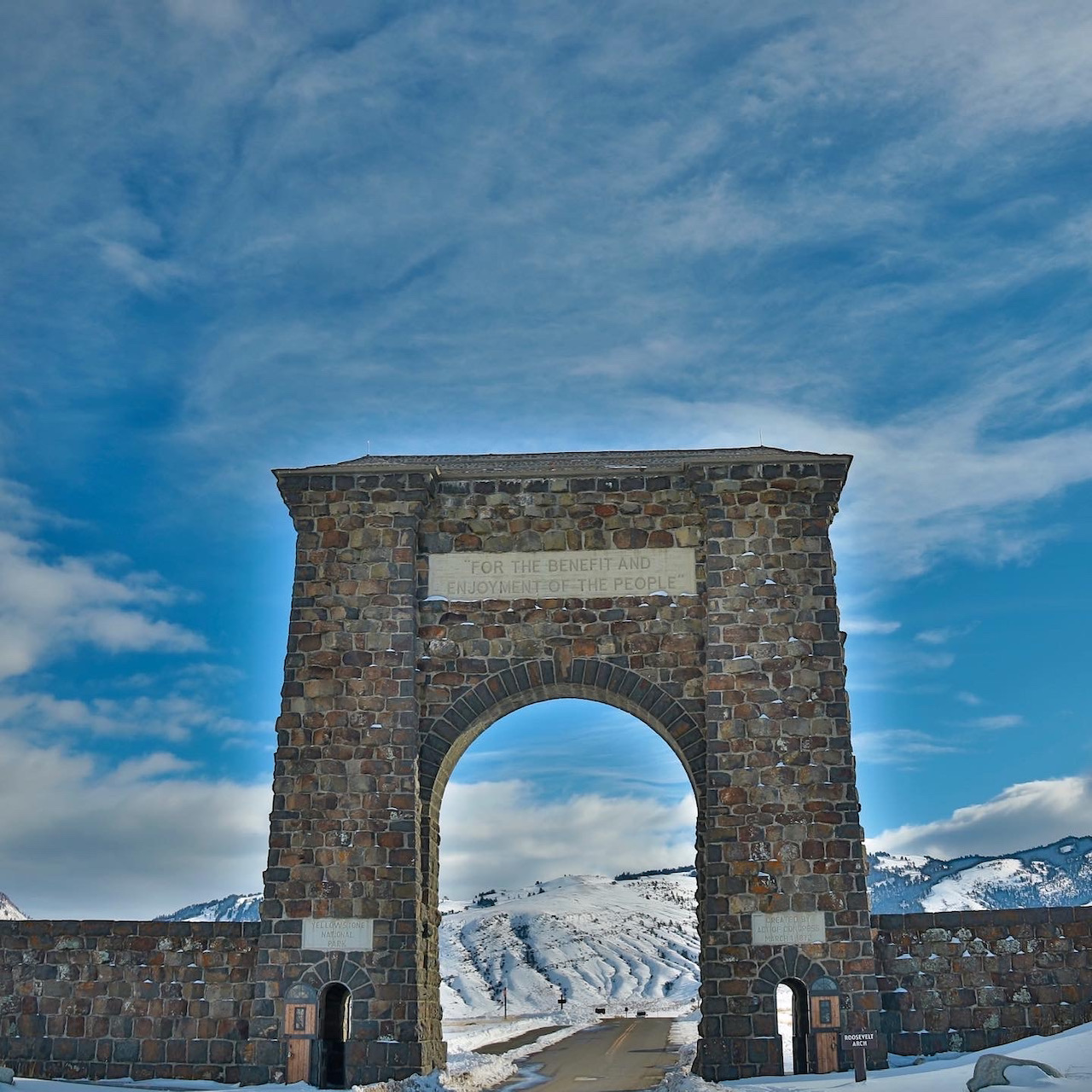
If you’re visiting Yellowstone this week with your own car, chances are you’ll enter through the park’s North Entrance. The drive is familiar: off Interstate 90 at Livingston, south on Highway 89 through Paradise Valley, with the Yellowstone River alongside you much of the way. You’ll pass through Yankee Jim Canyon and begin the approach to Gardiner. Most visitors stay on Highway 89 straight into town. But there’s a quieter turnoff before Gardiner, one that offers scenery, wildlife, and history well before the Roosevelt Arch comes into view. That road is Old Yellowstone Trail South.
Between Yellowstone Hot Springs and Gardiner, Old Yellowstone Trail South follows a lightly traveled corridor along the Yellowstone River that echoes early automobile travel, railroad history, ranching life, and long-standing wildlife migrations. This isn’t the paved North Entrance Road inside the park, but a mostly dirt-and-gravel county road that once formed part of the original Yellowstone Trail, one of America’s first transcontinental auto routes. Before Highway 89 became the main gateway, this road carried tourists, supplies, and settlers toward Yellowstone.
The section of road I am recommending begins near Yellowstone Hot Springs, roughly seven to eight miles north of Gardiner. After crossing the bridge over the Yellowstone River, turn left and head toward Gardiner. Keep an eye out immediately, as this section of road is great for bighorn sheep and bald eagle sightings. You’ll climb a bit to get away from the river, and then the valley opens wide, with river-bottom pastureland stretching out. Sagebrush flats blend into cottonwood groves, and the Absaroka Range rises dramatically. On clear days, Electric Peak commands attention to the southwest, its dark volcanic mass standing apart from the surrounding ridges. Sepulcher Peak rises steeply, a familiar landmark to early soldiers, explorers, and travelers approaching Yellowstone from the north. Nearby, almost directly to your right after you climb away from the river, Devil’s Slide comes into view, a striking limestone formation tilted sharply upward, long used as a visual marker by Indigenous travelers, railroad surveyors, and motorists alike.
For several miles, the road parallels the river just out of view, passing through excellent habitat. Elk are common here, especially during seasonal migrations. Pronghorn roam the sagebrush flats, birdlife is abundant, and in winter, bison sometimes appear as they move north out of the park.
About halfway along, the road quietly enters Yellowstone National Park, no gate, just an old sign and a creek crossing. Soon after, you’ll pass the closed road to the Stephens Creek bison facility, a modern chapter in Yellowstone’s bison story that now supports relocating disease-free bison to tribal lands and conservation herds.
As the road approaches Gardiner, it opens into the Gardiner Basin. On a hillside above town sits the Gardiner Cemetery, established in the early 1900s. It holds the graves of railroad workers, soldiers, settlers, and families who lived at Yellowstone’s rugged northern gateway. The view from here stretches across the river and valley toward Electric and Sepulcher peaks, tying human history directly to the landscape.
Gardiner developed as Yellowstone’s original year-round entrance, shaped by tourism and the railroad, which reached town in 1903. Old Yellowstone Trail South delivers you to its edge with sweeping views back across the route you’ve traveled. It’s not a shortcut, but if you want your Yellowstone experience to begin before the park gate, it’s a road worth taking.
RANDOM YELLOWSTONE FACT OF THE WEEK
The Possible Fate of the Bison Heading to Gardiner
Every winter, Yellowstone’s bison do what they’ve always done: move. As snow deepens and forage becomes harder to reach, some herds drift north toward the lower elevations around Gardiner, Montana. When they cross the park boundary, their lives change quickly, and they enter one of the most tightly managed wildlife systems in the country.
You’ve probably seen the iconic images of bison passing beneath the Roosevelt Arch in Gardiner. While many people love the idea of bison freely roaming beyond the park, the reality is often darker. For some animals, leaving Yellowstone leads to death. For others, it opens a path to relocation and restoration elsewhere. The system is complicated and deeply contested.
Outside the park, bison are managed under the Interagency Bison Management Plan, a partnership among the National Park Service, the State of Montana, federal agencies, and Tribal nations. The goal is to maintain a wild, free-roaming bison population while addressing concerns about brucellosis, a disease that can affect livestock. What happens to individual bison depends on where they go and how many animals are on the move.
One key component is the Indigenous hunt. Several Tribal nations have treaty and management rights to harvest Yellowstone bison once they leave the park. These hunts are not symbolic; they provide food, hides, and a powerful cultural connection that stretches back thousands of years. For many Tribal members, harvesting bison represents food sovereignty and cultural restoration after near-extinction.
Some bison are instead captured at the Stephens Creek facility near Gardiner. There, animals are held, tested for brucellosis, and sometimes placed into a multi-year quarantine program. Those that pass are relocated through the Bison Conservation Transfer Program. Since 2019, hundreds of Yellowstone bison have been transferred to Tribal lands, including the Fort Peck Reservation, and then on to Tribal nations across the country.
Not all bison survive. In heavy migration years, some are culled as part of population management. Historically, removals have ranged from hundreds to more than 3,000 animals, especially in the early 2000s. Management has shifted toward greater tolerance, but controversy remains.
In recent years, management was shifting toward greater tolerance, but since the 2024 election, the pendulum has swung the other way. The positive is that there is more Tribal involvement and fewer large-scale slaughters, but the system is still controversial. The state of Montana is currently suing the NPS over its bison plan. At the heart of the state’s lawsuit is the demand to reduce Yellowstone’s bison population to 3,000 animals. About 5,400 bison currently roam in the park. This demand comes despite the new plan setting forth a population range that is well within the 10-year average that has allowed Yellowstone managers to successfully maintain separation between bison and cattle, resulting in zero brucellosis transmissions and few conflicts with landowners north and west of the park.
What happens to bison near Gardiner is a blend of conservation success, cultural revival, and hard trade-offs, messy, imperfect, and deeply human.
WEATHER FOR THE COMING WEEK
I am too lazy to type it all out, so you’ll have to listen to the podcast to get the weather forecast, or just contact me.
Apple: https://podcasts.apple.com/us/podcast/this-week-in-yellowstone-national-park/id1789397931
Spotify: https://open.spotify.com/show/41E5WWldz4s7n6NXh2Lahr
RSS: https://rss.com/podcasts/this-week-in-yellowstone-national-park/
SNOWPACK UPDATE
As of January 28th, the snowpack is around 100% of normal for this time of year. Last year on this date, we were averaging around 75% of our normal level. Limited snow in the forecast isn’t going to help this year’s numbers.
ROADS CONDITIONS
The only road open is the road between Gardiner, Montana, and Cooke City, Montana. Please be aware that this road can close at any time due to inclement weather.
For up-to-date information, call (307) 344-2117 for recorded information, or sign up to receive Yellowstone road alerts on your mobile phone by texting “82190” to 888-777.
CAMPING INFO
There is only one campground open in the park right now, and that is the Mammoth Campground, which is open year-round.
WILDLIFE WATCHING UPDATE
You have to listen to the podcast to get this information. Sorry.
Apple: https://podcasts.apple.com/us/podcast/this-week-in-yellowstone-national-park/id1789397931
Spotify: https://open.spotify.com/show/41E5WWldz4s7n6NXh2Lahr
RSS: https://rss.com/podcasts/this-week-in-yellowstone-national-park/
PICK UP A GUIDEBOOK
Love what you have heard on this podcast and want more information on wildlife watching? Get a copy of my wildlife-watching guidebook to the region! Available in both ebook and paperback formats, my book will help you spot wildlife like a seasoned local. Please consider buying a book directly from me, as I make next to nothing when they are sold on Amazon. Grab your copy now at outdoor-society.com!
TRAIL ALERTS AND UPDATES
There are no official trail alerts this week.
Honestly, the snow in much of the park is quite poor, which makes recommending a specific area for snowshoeing less than ideal. I know that new snow has fallen since last weekend, but we still need more before snowshoeing really gets good.
TREK OF THE WEEK
Beaver Ponds
Continuing with my theme of trails I don’t normally recommend this time of year, but will because the snow isn’t good elsewhere, this week I am suggesting a Beaver Ponds jaunt. This trail will have you spotting elk, bison, pronghorn, and maybe even coyotes and foxes. It could even reward you with birds, but probably not beavers. What makes this a good hike for the coming week is that it has great mountain views, sweeping panoramas, cool forest sections, and frozen ponds. You will need decently aggressive traction devices and trekking poles at a minimum. Snowshoes can be brought, but will only be desired in a couple of places where you could honestly just make-do without them. Also, while I typically suggest walking this trail clockwise, this week I am suggesting doing it counterclockwise, climbing the hill behind the Mammoth Hotel, and ending by Liberty Cap. The reason for this is one section near the pond that could have some deeper snow, and is easier to go down than up.
Starting from the back of the lodge, the trail immediately begins climbing into the sagebrush hills above the Gardner River. Going counterclockwise means you tackle the elevation gain first, with switchbacks that open up expansive views toward Electric Peak, Sepulcher Mountain, and the Yellowstone River corridor. This dryer, open section, is a good place to spot wildlife like elk, pronghorn, bison, and coyotes. Also scan the skies for hawks and eagles. Oh, and don’t forget to scan Mount Everts, as you may see elk, bison, deer, or even bighorn sheep over there!
As you crest the higher ground, the trail levels out and transitions from open hillsides into mixed forest. This middle stretch feels more remote, and in some snow, it can feel a little sketchy. If you feel overwhelmed here, feel free to turn back and enjoy the sage section again. If you want to keep going, know that the trail gradually descends toward the heart of the loop, where the landscape changes dramatically.
The final portion of the counterclockwise loop drops you into the beaver pond complex itself. Multiple ponds, channels, and marshy areas line the trail, shaped by decades of beaver activity. Expect to see the pond fully frozen over and snow-covered, possibly with animal tracks over it. This section can be muddy or icy depending on the season, but it’s also the most peaceful and wildlife-rich part of the hike. Before you loop around the pond, make sure you take a break and enjoy the flank of Sepulcher Peak in the distance. I often make this my lunch spot, espcially on a sunny day.
After enjoying the views of the frozen pond, the trail then follows Clematis Gulch back toward Mammoth, tracing a small creek through the forest and meadow before reconnecting with the Mammoth terraces. The full loop is about 5 miles with roughly 350 feet of elevation gain, making it a moderate hike that packs a lot of variety into a relatively short distance.
NEXT WEEK
In the next episode, I’ll return with all of the information you need to have a good week in the park, including wildlife, weather, and trail updates.
Until then, book a tour with me, pick up a guidebook of mine, and happy trails!