 by
by 
This week in Yellowstone National Park, from October 9th through October 15th, 2025, I give you tips on how to manage the lack of amenities in the park this time of year, remind you that time is running out for driving in some cool areas of the park, give you the name of an app for wildlife watching, and share a perfect trail for this time of the year. I will also give you the complete weather forecast, a cool trail to hike, the wildlife report, the news, and everything else you need to have an incredible time, “This Week in Yellowstone.”
LISTEN TO THIS AS A PODCAST
Apple: https://podcasts.apple.com/us/podcast/this-week-in-yellowstone-national-park/id1789397931
Spotify: https://open.spotify.com/show/41E5WWldz4s7n6NXh2Lahr
RSS: https://rss.com/podcasts/this-week-in-yellowstone-national-park/
Disclaimer: I may miss a few details, so please feel free to reach out with any questions. I also mention park locations casually—if you’re unfamiliar, a quick search can help.
Also, this podcast is a passion project—I’m not paid or sponsored. If you enjoy it, I’d love a review or a quick email! To support my work, check out my guidebooks on hiking and wildlife watching, or join me for a guided Yellowstone tour. For details, visit outdoor-society.com or reach out directly!
THIS WEEK’S YELLOWSTONE NEWS
This week, there’s growing concern for grizzlies around Yellowstone. 2025 is shaping up to be one of the deadliest years on record for grizzly bears across the Greater Yellowstone Ecosystem.
According to National Parks Traveler, federal biologists have confirmed at least 63 grizzly deaths so far this year, already surpassing last year’s record pace for the first nine months.
Wildlife managers say many of those deaths are tied to hunter conflicts during Wyoming’s fall elk season, when bears move into lower elevations looking for food. And with drought conditions and a poor berry crop this summer, the grizzlies are hungrier and more likely to cross paths with people.
September alone saw 17 new mortalities added to the list, and more may still be unconfirmed. In one recent case, Wyoming Game and Fish had to capture and relocate two orphaned cubs that kept wandering onto private property after their mother disappeared.
All of this is happening as political pressure mounts to remove Yellowstone grizzlies from federal endangered species protection. Legislation to delist the grizzly population is a hot-button issue in Montana, Wyoming, and Idaho, with those for the killing of bears arguing that the bears have recovered. But conservationists counter that rising deaths, climate stress, and human conflicts show the species still needs protection.
For now, wildlife experts are urging hunters, residents, and visitors to stay bear aware and to recognize that every individual loss affects the fragile balance of the Yellowstone ecosystem.
Next up, as of right now, there are no updates on the Government Shutdown or what it means for Yellowstone. With interior gates closing in on October 31st, and visitation numbers dropping every week, I expect the park to remain open until the end of the month. Then, only the northern range, from Gardiner to Cooke City, will be open, as is the norm.
EXPERIENCE OF THE WEEK
One Last Trip On Yellowstone’s Hidden Side Roads
While most visitors stick to the Grand Loop, which connects the park’s big names, some of Yellowstone’s most peaceful and beautiful places lie just off to the side. These short detours, which are the park’s “side roads,” lead to waterfalls, wildlife-filled valleys, and incredible overlooks. In the summer, they’re perfect for slowing down, escaping the crowds, and discovering a quieter side of Yellowstone that many people miss. In October, these seasonally open roads are nearly empty, giving you a perfect place to find serenity and calm, as well as one last chance to experience driving in Yellowstone off the beaten path.
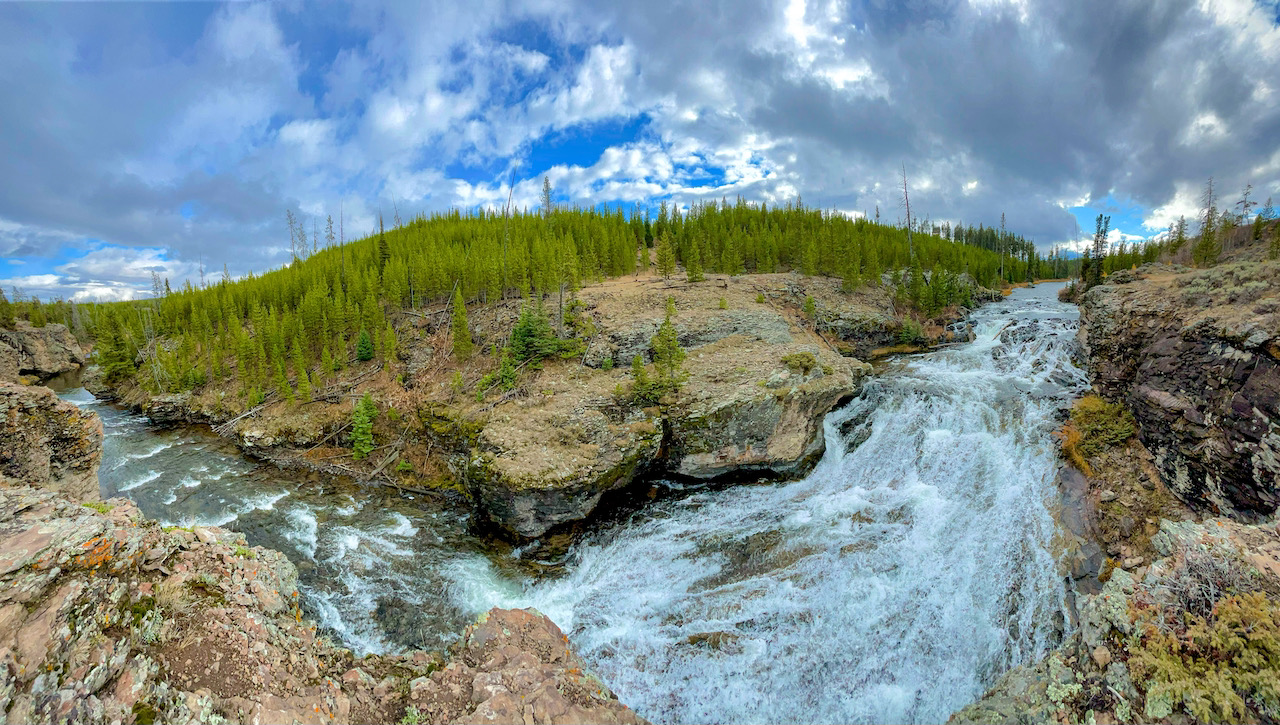
Near Norris Junction, the Virginia Cascades Drive is a hidden gem. This scenic, two-and-a-half-mile one-way road follows the Gibbon River through a shaded canyon. The highlight is Virginia Cascades, a 60-foot waterfall tumbling over volcanic rock. It’s an especially lovely spot in the morning light, and a great place for a picnic or a photo stop. The road is narrow and closed in winter, but when open, it’s a refreshing escape into the woods.
Heading south toward Madison Junction, Firehole Canyon Drive offers a completely different experience. Just two miles long, this one-way road winds through a narrow canyon carved by the Firehole River. You’ll pass Firehole Falls, a thundering 40-foot cascade framed by dark lava walls. It’s a short detour that feels worlds away, with the scent of pine in the air and the sound of rushing water echoing through the canyon.
Up north, between Mammoth Hot Springs and Tower-Roosevelt, the Blacktail Plateau Drive is a must for wildlife lovers. This six-mile unpaved road meanders through meadows, forests, and rolling hills, a perfect backdrop for spotting elk, pronghorn, bison, and even bears. The dirt road can be bumpy, so it’s best for cars with decent clearance, but the slower pace is part of its charm. It’s one of those places where you might not see another car, just endless sky and open Yellowstone country.
For breathtaking views, nothing beats the North and South Rim Drives at Canyon Village. Sure, these roads are more well-known, but they are still worth your time. Plus, you’d be surprised how many people visit the park and never wander the canyon area. These short paved spurs showcase two different perspectives of the Grand Canyon of the Yellowstone. Along the North Rim, stops like Brink of the Lower Falls, Grand View Point, and Inspiration Point offer jaw-dropping looks into the canyon’s golden depths. Across the river, the South Rim leads to Artist Point, one of the park’s most famous viewpoints, where the Lower Falls plunge dramatically between sunlit canyon walls streaked in impossible-to-describe colors. It’s a sight that never fails to awe, no matter how many times you’ve seen it.
If you’re after solitude, head east to Slough Creek Road, a two-mile gravel spur branching from the main road through Lamar Valley. This quiet stretch leads to the Slough Creek Campground and trailhead, a favorite among anglers, hikers, and wildlife enthusiasts. Bison often wander right down the road, and it’s not uncommon to spot wolves or bears in the distance. It’s a peaceful place to experience Yellowstone’s wilder side, especially at sunrise or sunset when the valley glows and the animals stir.
Outside the park, starting in Gardiner, Montana, the Old Yellowstone Road offers a glimpse of the area’s early history. Stretching about seven miles to Yellowstone Hot Springs, this gravel road follows part of the original stagecoach route into the park. It winds above the Yellowstone River, with sweeping views of the Gardiner Basin, Devil’s Slide, and the surrounding Absaroka Mountains. Pronghorn and elk graze along the hillsides, while eagles soar overhead. The drive ends at Yellowstone Hot Springs, a relaxing spot to soak in natural mineral pools while enjoying a panorama of mountains and river.
And if you’re up for an adventure, don’t skip Chittenden Road, which branches off the Dunraven Pass road between Canyon and Tower. This steep, five-mile gravel road climbs toward Mount Washburn, offering breathtaking views with every turn. At the top, the Chittenden Parking Area marks the start of the Mount Washburn Trail, one of the park’s most scenic hikes. On clear days, you can see for miles across Yellowstone’s rugged peaks and valleys. The road isn’t suited for RVs, but for anyone seeking mountain grandeur, it’s unforgettable.
Each of these drives captures a different side of Yellowstone, from roaring waterfalls to wide-open plateaus and quiet stretches where bison graze undisturbed. They remind you that Yellowstone’s beauty isn’t confined to its famous landmarks. It lives in the sound of a river echoing through a canyon, the sight of antelope on a windswept hill, and the stillness of a road where time seems to slow down.
So before you head home from your next trip, take one last detour. Wander down a side road. You might find your favorite Yellowstone memory waiting there, far from the crowds, tucked along a quiet bend in the road.
TIP OF THE WEEK
How to be Ready for a Lack of Amenities in the Park
If you’re heading into Yellowstone National Park this week and planning to find places to grab a bite or stock up on drinks while exploring, you’ll need to plan ahead. Food options inside the park are extremely limited this time of year.
During the summer, visitors can choose from several restaurants, cafés, and snack bars scattered around the park’s main attractions. However, in October, nearly all of those options close for the season. Currently, only a handful of dining spots remain open, and they’re concentrated in three areas: Old Faithful, Canyon, and Mammoth.
Food Options Inside the Park
Old Faithful Area
Old Faithful Snow Lodge: Open until the end of the month, serving breakfast, lunch, and dinner daily.
Bear Paw Deli: Open through October 13, typically from 7:00 a.m. to 5:00 p.m.
Obsidian Dining Room (Snow Lodge): Serving breakfast from 7:00–10:00 a.m., lunch from 11:30 a.m.–2:00 p.m., and dinner from 5:00–9:00 p.m., also open through October 13.
Canyon Village Area
The Eatery, Falls Café, and M66 Lounge are open through October 26.
Most operate from 11:00 a.m. to 8:00 p.m.
Washburn Lookout: Open until October 25, offering grab-and-go food and coffee from 7:00 a.m. to 3:00 p.m.
Mammoth Hot Springs Area
Mammoth Dining Room (inside the Mammoth Hot Springs Hotel) remains open year-round, serving breakfast, lunch, and dinner.
Hours: 7:00–10:00 a.m., 11:30 a.m.–2:00 p.m., and 5:00–9:00 p.m.
Terrace Grill: Open daily 10:30 a.m.–6:00 p.m. through October 13, after which it closes for the season.
Please note: most gift shops throughout the park have now closed for the year. Due to the ongoing government shutdown, museums, visitor centers, and ranger stations are closed, and the bathrooms located in those buildings are locked. However, pit toilets remain open throughout the park, and restrooms inside the lodges are available to the public.
A few self-service gas stations inside the park are still operating, but fuel can be limited. It’s wise to fill your tank before entering, in West Yellowstone, Gardiner, or Cooke City. The gas will be slightly less expensive and will be dependable.
Stocking Up Before You Enter the Park
Since dining options inside Yellowstone are few and far between right now, the best way to make sure you have food and drinks for the day is to stock up before entering the park.
If you’re staying outside the park, like most visitors this time of year, you’ll likely be based in West Yellowstone, Gardiner, or Cooke City. Both West Yellowstone and Gardiner have grocery stores and several restaurants that remain open year-round.
In West Yellowstone:
Market Place (located on Dunraven Street): A full-service grocery store open daily from 7:00 a.m. to 9:00 p.m., offering deli items, fresh produce, snacks, and beverages.
Food Roundup Supermarket (Yellowstone Ave): Another excellent option, open 7:00 a.m. to 9:00 p.m., with groceries, pre-made sandwiches, and drinks.
In Gardiner:
Gardiner Market: The town’s main grocery store, open daily from 7:00 a.m. to 8:00 p.m., offering fresh produce, deli items, and grab-and-go meals.
There’s also a gas station with a convenience store in town, and a big Sinclair station just a few miles north of town.
It may sound simple, but the best approach right now is to pack food and drinks for your full day in the park. This allows you to picnic anywhere, stay flexible with your plans, and make the most of your time watching wildlife, hiking, or exploring without having to leave a beautiful area just to find a meal.
There are 52 designated picnic areas throughout Yellowstone, all equipped with picnic tables and pit toilets. With proper planning, you’ll be ready for a full day of adventure—without worrying about where to find lunch.
Every year around this time, visitors are surprised by how few dining options remain open. So, expect that there may be no food service available anywhere, and when you do happen to find a meal at Old Faithful, Canyon, or Mammoth, you’ll be pleasantly surprised.
RANDOM YELLOWSTONE FACT OF THE WEEK
If you spend any time in Yellowstone, especially hanging around places like Lamar Valley or Hayden Valley, you’ve probably heard people tossing around names of pullouts and landmarks that don’t show up on any official park map. That’s where the Yellowstone SPOTR app, short for Sights & Panoramas Observed Traveling Roads, comes in. It’s basically your insider’s guide to the park’s best roadside wildlife-watching spots.
The app maps out tons of popular pullouts across Yellowstone, places like the Northern Range, Dunraven Pass, Hayden Valley, and Yellowstone Lake. Tap on a pullout, and it shows you what you can see from there, complete with photos, panoramic views, and even notes about which mountains, valleys, or other features you’re looking at. It’s the kind of info that usually takes years of visiting the park (and eavesdropping on hardcore spotters with scopes) to learn.
The app does work offline, so that is nice. Once you’ve downloaded the content, you don’t need cell service, which, let’s be honest, is almost nonexistent in most of Yellowstone. You can open the map, hit “Spot Me” to see where you are, and scroll through pullouts nearby. You can also search by name or coordinates if you’re trying to track down a particular viewpoint you heard someone mention.
SPOTR also connects with another app called Yellowstone Wolves, which helps you figure out which wolf packs are visible from certain areas. For anyone hoping to catch a glimpse of the Junction Butte or Rescue Creek packs, that’s a pretty awesome tool to have in your pocket.
There are a few things to keep in mind, though. A lot of the names used in the app aren’t “official,” they’re part of the local lingo that longtime watchers use, so you won’t find them on NPS maps or signs. The app also focuses on certain areas known for wildlife, so it doesn’t cover every road or trail in the park. And if it’s your first time using it, the sheer number of pullouts and sight names can be a little overwhelming. But once you play around with it, it starts to make a lot more sense.
Overall, the Yellowstone SPOTR app is a good tool to use if you have eavesdropped on the “serious” wildlife watchers and are curious about what they are talking about. Whether you’re hoping to see wolves, grizzlies, or just want to know what everyone’s staring at through their spotting scopes, this app gives you a leg up. It’s like having a local guide right in your pocket, minus the bear spray and all of the knowledge that someone like me can provide.
SNOWPACK UPDATE
Not in this week’s episode. This will be back in a few weeks, hopefully.
ROADS CONDITIONS
All major roads and most side roads are open right now in and around Yellowstone National Park. This includes Dunraven Pass, but not the Beartooth Highway, which, at the time of writing this, is still closed. However, snowfall this weekend could cause road closures. And with a limited staff to potentially clear roads if that is needed, they may remain closed for a few days.
For up-to-date information, call (307) 344-2117 for recorded information, or sign up to receive Yellowstone road alerts on your mobile phone by texting “82190” to 888-777.
CAMPING INFO
By the end of this week, the only campgrounds in the park that will be open are Madison, which closes on the 19th, and Mammoth, which is open year-round. Fishing Bridge RV Park is closing on the 12th. Slough Creek closes on the 13th, as does Lewis Lake.
WILDLIFE WATCHING UPDATE
You have to listen to the podcast to get this information. Sorry.
Apple: https://podcasts.apple.com/us/podcast/this-week-in-yellowstone-national-park/id1789397931
Spotify: https://open.spotify.com/show/41E5WWldz4s7n6NXh2Lahr
RSS: https://rss.com/podcasts/this-week-in-yellowstone-national-park/
PICK UP A GUIDEBOOK
Love what you have heard on this podcast and want more information on wildlife watching? Get a copy of my wildlife-watching guidebook to the region! Available in both ebook and paperback formats, my book will help you spot wildlife like a seasoned local. Please consider buying a book directly from me, as I make nothing when they are sold on Amazon. Grab your copy now at outdoor-society.com!
WHAT IS CLOSING THIS WEEK
Bridge Bay is fully closed
Canyon General Store closes on the 12th
Fishing Bridge will be fully closed on the 12th, the RV park closes on the 11th, and the general store on the 12th.
Lewis Lake Campground closes on the 13th
Lake Village is fully closed
Madison Campground closes on the 19th
Mammoth Terrace Grill closes on the 13th
Old Faithful Inn closes on the 13th, with lodging closing on the 12th.
Slough Creek Campground closes on the 13th
TRAIL ALERTS AND UPDATES
The Turbid Lake Trail is still closed, and for those of you hoping to do the Yellowstone River Overlook Trail, know that the Yellowstone River Picnic Area and the Specimen Ridge West Trailhead are closed. You can still hike it, you just need to park at pullouts 1/4 mi east to access Specimen Ridge Trail. All the information on trail conditions can be found on the Backcountry Conditions Page of Yellowstone National Park. It isn’t always updated, but it is better than going in without any knowledge.
TREK OF THE WEEK
This week, I am once again suggesting you take this time to hike the Grand Prismatic Overlook-Fairy Falls-Imperial Geyser route. I recommended this hike at the end of May, and am doing so again because you only have a few more weeks to do it before the interior of the park is closed. There is a much longer route that is 13 miles and takes you to even more remote corners of the region, but this is the shorter trek. If you want info on that long one, shoot me a message. Or, better yet, book a hiking tour with me!
This classic hike begins by crossing the Firehole River Bridge and following the historic Fountain Freight Road, once known as National Park Avenue, tracing the southern edge of Midway Geyser Basin. Almost immediately, look to your right for one of Yellowstone’s crown jewels: Grand Prismatic Spring.
Now, before I jump into the description of the hike, I want to say a few things. This time of the year, I suggest hiking straight to Imperial Geyser Basin, then taking in the sights on the way back. Doing so, espcially on a cold morning, can have you walking through an icy wonderland when you reach the steamy sections near Imperial. It is truly stunning and worth waking up early to experience. Also, please know that despite the popularity of this trail, wildlife sightings are common. Just last week, a grizzly ran in front of dozens of people near the Grand Prismatic Overlook trail. Now, with that knowledge, I’ll jump to the trail review.
At around the one-mile mark, the trail veers left off the old road and slips into a forest that tells a dramatic story of renewal. The area was ravaged by the 1988 fires, which transformed the dense, aging lodgepole pine forest into a rejuvenated landscape. The fire opened up the canopy, allowing sunlight to revive grasses, wildflowers, and a burst of new life. As you stroll, keep an ear out for the rustle of animals, both small and large.
Continue on this trail until you reach 2.5 miles, where the sound of tumbling water guides you to Fairy Falls. Water from Fairy Creek cascades nearly 200 feet off the Madison Plateau into a serene pool below. Named during the 1871 Hayden Survey for its “graceful” descent, Fairy Falls is a picture-perfect display of nature’s delicate yet powerful force. It is also a great spot to catch some fall colors.
Just a half mile further west lies Imperial Geyser. To reach this, follow a sometimes swampy, sometimes muddy trail away from the falls and creek.
This leads to Imperial Falls. In the 1920s, its powerful 80-foot eruptions from a 100-foot crater captivated visitors, even inspiring a naming contest. Although Imperial Geyser now simmers quietly, its bubbling overflow still commands attention. A short 0.2-mile walk east along its runoff channel will lead you to Spray Geyser, a smaller yet consistently active wonder that shoots water up to 6 feet through multiple vents.
For those feeling adventurous, consider hiking the steep trail that ascends from the base of Imperial Geyser. Although the climb can be challenging, it rewards you with a spectacular birds-eye view of Imperial and, if you continue on, a breathtaking overlook of Fairy Falls in its entirety. Along the way, a modest lake comes into view on your left; while simple in itself, it frames the panorama of falls and rugged cliffs beautifully.
Hike back the way you came, enjoy the falls, and then hike up to the Grand Prismatic Overlook for the final stop on your trek. This hike offers a front-row seat to Yellowstone’s dynamic contrasts, from boiling, colorful springs and steaming overlooks to fire-forged forests reborn with life and thundering waterfalls. Every twist and turn reveals another chapter in this ever-changing natural masterpiece, inviting you to pause, observe, and marvel at the wonders of the park.
The total distance on this will be around 7 miles and roughly 400 feet of elevation gain.
NEXT WEEK
In next week’s episode, I’ll return with all of the information you need to have a good week in the park, including wildlife, weather, and trail updates.
Do you have a question you’d like answered on the podcast? Message me and I will try to cover it!
Until then, happy trails!